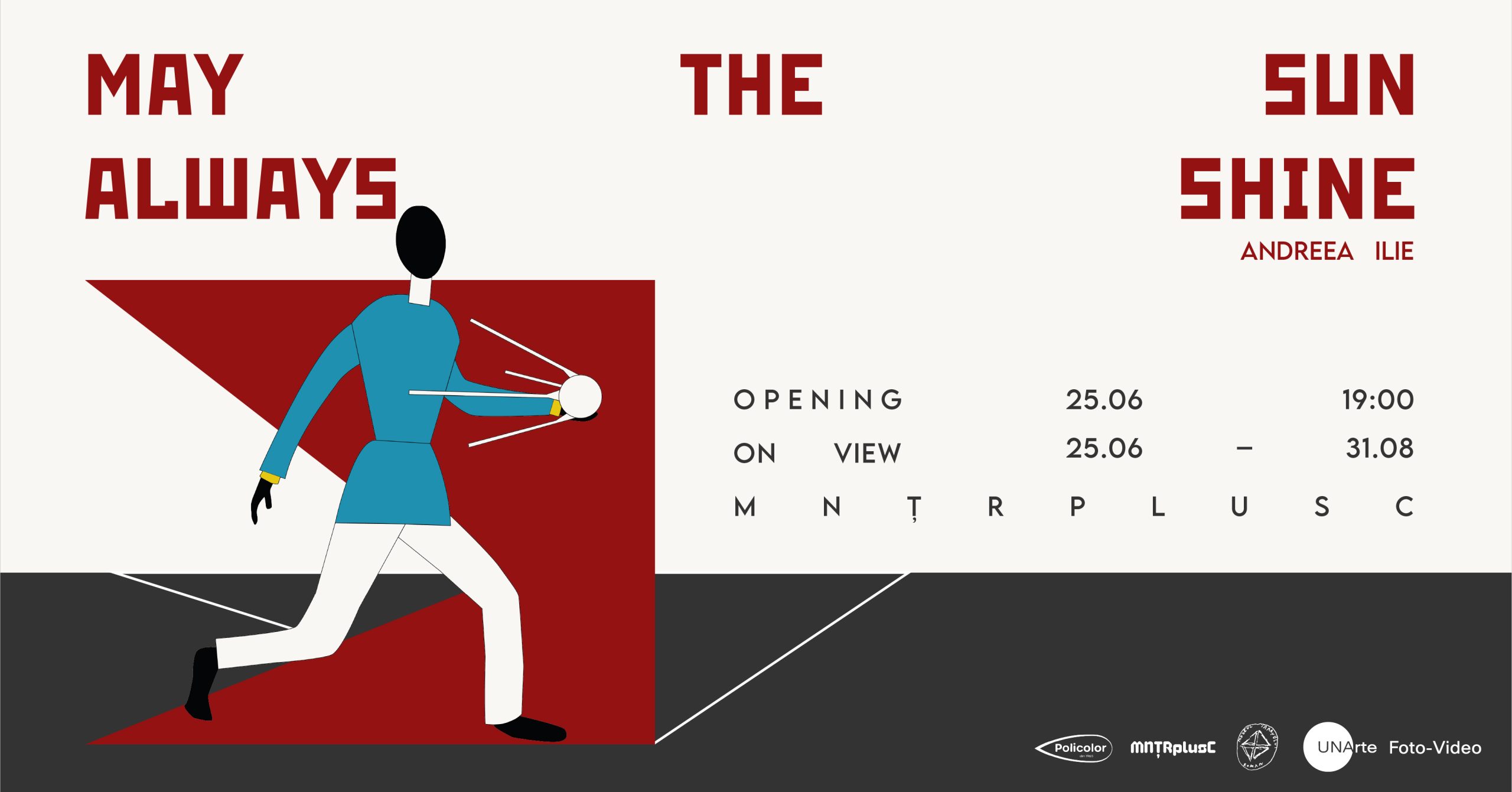
On 25 June 2026, at 19:00, the MNȚRplusC space within the National Museum of the Romanian Peasant (3 Monetăriei Street, Bucharest) will host the opening of “May the Sun Always Shine”, a solo exhibition by artist Andreea Ilie. The project represents her diploma work at the National University of Arts Bucharest and proposes a rigorous visual investigation into the mechanisms of Soviet propaganda and the ways in which they continue to shape collective imagination.
Grounded in extensive visual and historical research, the exhibition explores how the political symbols of Soviet propaganda evolved from aggressive ideological instruments into seemingly naturalized elements of both domestic and public space. This subtle yet profound transformation lies at the core of the project: the normalization of ideology through its integration into everyday life.
“May the Sun Always Shine” examines this “total environment” across multiple scales simultaneously—from the monumental architecture of propaganda, public mosaics, and monuments, to the intimate, portable objects of childhood: enamel badges, red flags, and children’s publications. These fragments of visual memory are brought together into a critical archive of a political aesthetic that shaped entire generations.
Through a multidisciplinary approach, the artist combines ceramics, metalwork, and photography, isolating, enlarging, and recontextualizing these historical artifacts into contemporary art objects. This process of artistic translation does not aim merely at formal reconstruction, but at reactivating the latent meanings embedded within these objects.
Strongly influenced by post-Suprematist aesthetics, Andreea Ilie’s works reveal the deep tension between individual identity and collective uniformity. The visual language of the exhibition oscillates between geometric rigor and the fragility of memory, between ideological abstraction and the material presence of the object.
In this sense, the exhibition is not only an inquiry into the recent past, but also a meditation on how ideological images continue to circulate, transform, and shape our perception of the present.
“May the Sun Always Shine” thus emerges as an artistic and critical project that re-examines the relationship between power, image, and memory, offering the audience a complex visual reading experience at the intersection of archive and contemporary installation.