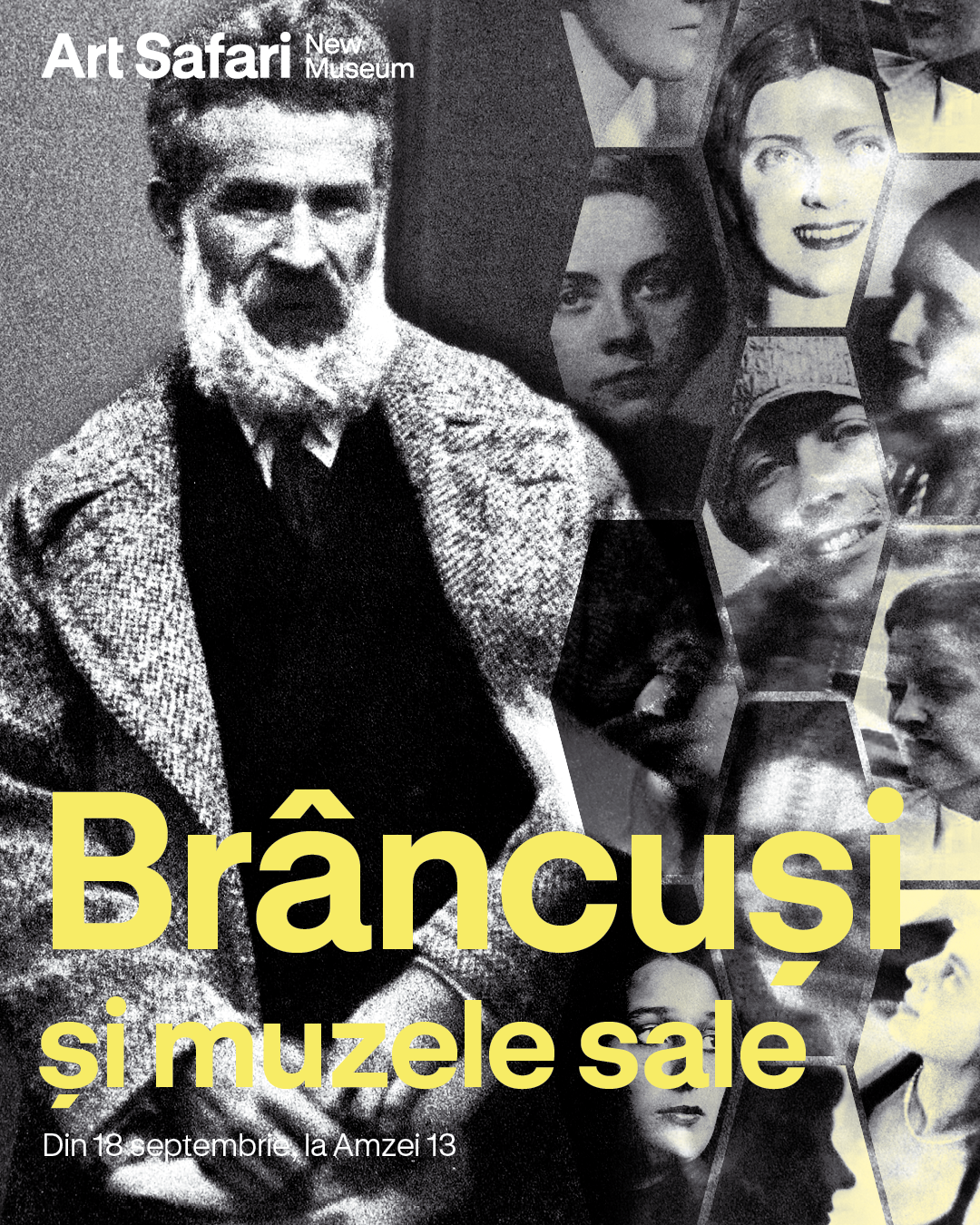
The exhibition “Brâncuși and His Muses,” organized by Art Safari New Museum as part of its second exhibition season of 2026, running from September 18 to December 20, takes its inspiration from curator Doina Lemny’s book Brâncuși et ses muses, published in 2023.
Adored and admired by the women who crossed the threshold of his studio, Brâncuși held them in high regard, elevating them to emblematic figures of femininity, which he translated into celebrated sculptures, photographs, and films—an artistic passion of his that remains less familiar to the general public.
“This exhibition, which is completely different from retrospective exhibitions that present only groups of sculptures, is exceptional because it opens a window into the artist’s intimacy, into his personality, which is often presented with simplicity,” says Doina Lemny, one of the most highly regarded international voices in Brâncuși scholarship.
The Female Universe That Shaped Brâncuși’s Life and Work
The public is invited to explore the intimate world of Constantin Brâncuși and his relationships with women—artists, writers, dancers, and gallery owners who visited his Paris studio, including Baroness Renée Irana Frachon (the model for Sleeping Muse), Margit Pogany, Lizica and Irina Codreanu, artist and writer Nancy Cunard, poet Mina Loy, dancers Marthe Lebherz, Florence Meyer, and Marina Shaliapin, as well as the artist’s final partner, pianist Vera Moore. They became his inspiring muses and close friends during a particularly creative period of his life.
Some of his lovers, who were a constant presence in his everyday life, such as Swiss dancer Marthe Lebherz and British-born pianist Vera Moore, remain documented in the archives through the extensive correspondence they maintained with the sculptor. His friend Margit Pogany, a Hungarian painter, inspired one of Brâncuși’s most celebrated sculptures, Mademoiselle Pogany, a version of which, from the collection of the Craiova Art Museum, will be presented at the Art Safari exhibition.
A number of myths and legends also emerged around these relationships, and visitors will discover them throughout the exhibition. One is the alleged love story between Brâncuși and Princess Marie Bonaparte. The artist never met her, but she is said to have inspired one of his famous sculptures, Princess X. Another legend concerns a supposed love affair between Brâncuși and Maria Tănase, whom he met at the 1939 New York World’s Fair and with whom he appears in only one photograph.
A Multi-Act Play
The exhibition is distinctive for its rich ensemble of photographs taken by Brâncuși, films, correspondence, posters, personal documents, and, above all, objects—dresses and jewelry—that belonged to these muses. It also features iconic works brought from the Victoria & Albert Museum in London and the Nouveau Musée National de Monaco, as well as previously unseen works from private collections.
“The exhibition is conceived as a multi-act play, in which each character stands out through what makes her most distinctive: Baroness Renée Irana Frachon, the model for Sleeping Muse, is represented through photographs and objects; Margit Pogany is represented in our exhibition through photographs, drawings, and the emblematic sculpture that secured her fame,” adds Doina Lemny.
40 Original Photographs by Brâncuși to Be Exhibited for the First Time
For the first time worldwide, the exhibition will present a previously unseen group of 40 original photographs by Brâncuși, discovered and identified by Doina Lemny in the collection of the University of Art and Design in Cluj-Napoca.
The photographs come from the archive of writer Otilia Cosmuța-Bölöni, one of Brâncuși’s closest and most devoted friends from his early Paris years—the person who introduced him to Rodin and who also introduced the artist to his first muses, Margit Pogany and Baroness Renée-Irana Frachon. The 40 photographs were donated to the University through an intermediary, Dr. Nicolae Maior of Oradea, at the request of Otilia’s heir.
“I had wanted to see these 40 photographs for a long time. I absolutely had to see them in person in order to certify their authenticity 100%! I am accustomed to all the photographs in the Brâncuși collection at the Centre Pompidou (approximately 2,000 negatives and prints), as well as those in other private collections. That is why, as I always do, I consulted photography experts,” continues Doina Lemny, the exhibition’s curator.
Film, Brâncuși’s Experimental Passion, Completes the Exhibition
Brâncuși was deeply curious about every new development in the field of visual imagery, and after reaching a professional level in photography, he purchased a film camera to explore this entirely new medium as well. The best-known films made by the artist depict dancers performing in his studio, surrounded by his sculptures.
“Several sequences demonstrate his approach as a filmmaker: the dances of these muses, the most famous of whom is Florence Meyer, daughter of wealthy American collectors Agnes and Eugene Meyer, owners of the Washington Post, as well as other dancers who are difficult to identify because—and this is where the artist’s mastery lies!—he films them covered, capturing only the movement of their hands,” adds Doina Lemny.
(Press release)