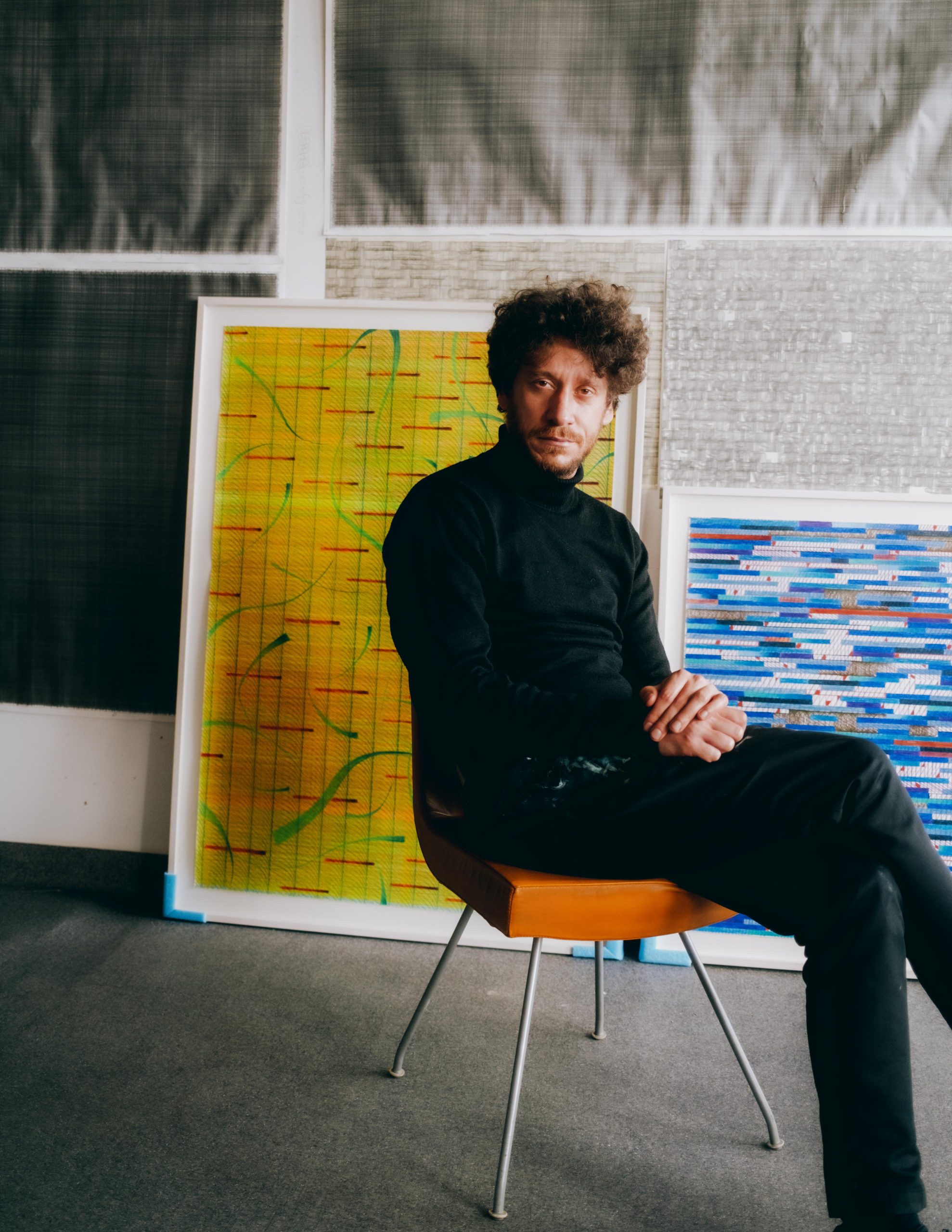
As part of his solo exhibition Numeric Space, presented at Relicvar Gallery in Cluj-Napoca, Norbert Filep chose to replace the conventional curatorial text with an interview conducted with himself. The dialogue functions as a mapping of his own research process, tracing the ways in which technical drawing, architectural instruments, and repetitive gesture are transformed into an artistic method and a way of thinking about space. From the traces left by templates to models projecting a future studio and a possible architecture of dwelling, the conversation reveals the internal logic of his practice. We are publishing this self-interview in its entirety, conceived by the artist as part of the exhibition.
M.S.: In recent years, your practice has been built around graphite drawing, defined by methodologies derived from architectural and technical drawing. How do you relate to these fields, or rather, to what extent do they influence you?
N.F.: I have always liked architecture. I find it fascinating how a drawing on paper—a multitude of lines laid out in different directions, conceived and intersected with precision—comes to determine the space occupied by the materials of a building. At the same time, what interests me in these fields is the set of tools through which the architect or engineer transferred ideas into a drawing that would later occupy physical space. These objects are increasingly falling out of use due to digitalization, and this is a key aspect from which my projects begin, where processes and objects are revalued through a conceptual inquiry.
M.S.: What were the main aspects that led to the development of this new direction in your artistic practice?
N.F.: I think an important part lies in my day-to-day work with these tools. For me, the entire dimension of drawing begins with the traces these instruments generate, which are in fact signs of a rigid system, completely different from the freedom and possibilities through which freehand drawing manifests itself. When you draw using templates, the line becomes precise, stubbornly mimicking the cut-out space of the shape being used. The mark left by the pencil somehow preserves a ghostly spirit of the template or ruler, which, in my case, becomes hidden through repetition. Constant interaction led me to look more closely at these objects, discovering that the repetitive pattern is already embedded in the drawings marked on them. I then became curious about their translucent colors and the material qualities through which different templates exist (wood, metal, plastic), which led me to use them for purposes other than the repetitive process of drawing. But beyond all these aspects, the primary source of these works lies in the utility of these objects—in their ability to measure the world around us and to use it to organize new concepts and perspectives within our immediate surroundings.
M.S.: How did you move from the two-dimensional space of paper to the three-dimensionality of these objects, which ultimately function as models for your own architectural project?
N.F.: What I tried to achieve through these models is essentially a combination of the idea of dwelling, the everyday need for a fixed space—especially a studio—and a practice based on the drawings generated by these objects. In this sense, the current project represents my own construction site, one that will unfold over the coming years.
M.S.: Do the models in the exhibition represent real construction projects for you?
N.F.: Some of them are very close to what will actually be built, while others are variations of an ideal world in which financial resources and architectural possibilities are not an issue, and imagination can move freely without obstacles. In short, the project is about the rehabilitation of a property in a rural area.
M.S.: This exhibition includes two new series of drawings. One of them is closely connected to your architectural interests. The other, however, operates on a figurative level—almost photographic. What relationship exists between your predominantly abstract approach and this new tendency to introduce photographic imagery into your practice?
N.F.: The connection to abstract space is achieved through the process of covering these figurative drawings. Figurative imagery becomes an element of slowed perception, where the drawn image is concealed beneath a network of lines. The new transparency that is created changes the reading of the image and directs the viewer toward a slower process of recognizing and assimilating visual information. Ultimately, it is the search for that subtle space in which the figurative is transformed into the abstract through the rules of a repetitive process.
M.S.: What direction do you want to move toward? Do you think that, with the introduction of three-dimensionality into your research, your drawing will be altered or redirected toward other perspectives? What other media would you like to develop in the coming period?
N.F.: I believe new and very interesting directions will emerge for me, bringing changes that will alter the trajectory of my practice. Although my research is primarily focused on repetitive processes, and at first glance these may seem hermetic, offering little visually, they actually operate on an extremely broad conceptual level. This encourages me to explore new possibilities across multiple media in the future. Of course, these new directions will differ from the visual space generated by graphite drawing. However, the processes and conceptual framework will retain much of their current logic, where information and repetition will define the new directions that emerge.
Numeric Space
Interview with MySelf / 25.05.2026