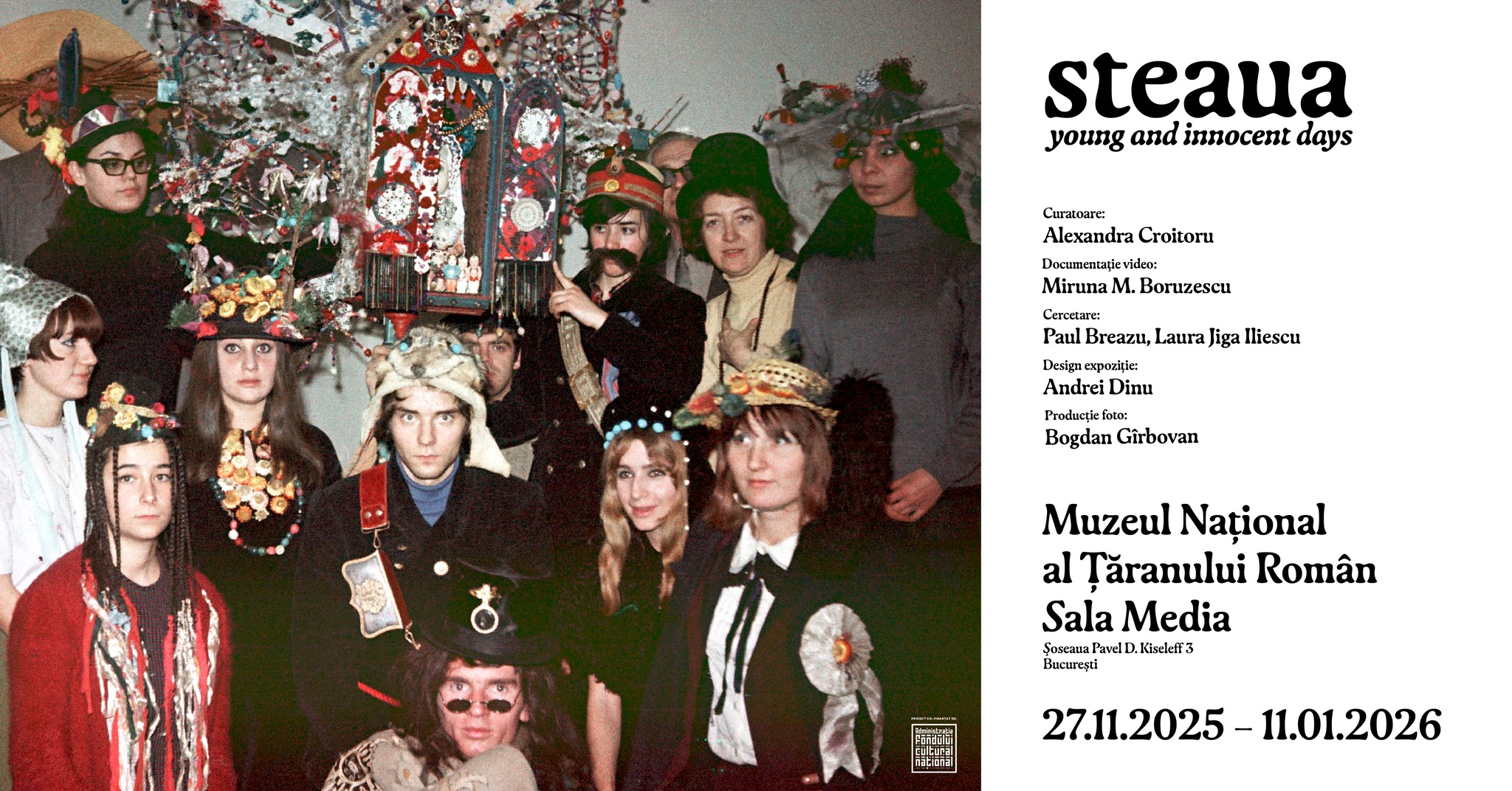
The opening on November 27, at 7:00 PM marks the start of the second part of the exhibition “steaua. young and innocent days” at the National Museum of the Romanian Peasant, Media Hall. It will feature both the artistic object that gives the event its title, as well as artistic and documentary contributions by Paul Breazu, Laura Jiga Iliescu and Miruna M. Boruzescu.
The exhibition is organized around the Christmas Star made in 1968 by a group of students from the Set Design Department of the “Nicolae Grigorescu” Institute of Fine Arts in Bucharest, presenting to the public for the first time the original object and photographs from that time, along with testimonies of several of the participants, recorded by Miruna M. Boruzescu in 2005. These materials are complemented by two research studies that place the Star in a broader social context: Paul Breazu’s installation discusses the pop culture of the youth of the 1960s from a double perspective – that of the Romanian press of the time and that reflected in various internal reports from the Radio Free Europe archive – while Laura Jiga Iliescu’s contribution offers a broader picture of the tradition of caroling with the star, with the help of a selection of photographs from the Image Archive of the National Museum of the Romanian Peasant.
In addition to the undeniable aesthetic qualities of the Star created by young students, this object also has the power to evoke the spirit of a generation that overflowed with an energy that exceeded the limits (and limitations) of the local sociopolitical context. The hybridization between the transnational spirit of the 1960s counterculture and the policies of the communist system, which explicitly discouraged individualism, produced in this case an intense collective ethos that still retains its potential to inspire us.
Although the end of the 1960s represented a moment of openness to Western culture in Romania in terms of access to books, magazines, music or cutting-edge films, the possibilities for artistic production were not similar to those in the West. Steaua is a fantastic assemblage of scrap materials that are today considered common, but at the time were perceived as extremely precious by the group members, being carefully collected for the production of models, sets and costumes. And if something really couldn’t be “found”, it was improvised with endurance, as in the case of the hundreds of handmade beads made of clay, dried and painted in the workshop on Transilvaniei Street. It is no wonder that Vladimir Șetran, one of the professors close to the group of students, carefully preserved Steaua for more than 50 years in his workshop, and its recent restoration made it possible for it to return to the cultural circuit. The conservation interventions were carried out by a team of specialists from the National Museum of the Romanian Peasant, at the initiative of Radu Boruzescu, one of the main organizers of the 1968 action.
The star was conceived from the beginning as a living object: on the one hand, it was ingeniously activated by rudimentary kinetic mechanisms, and on the other hand, it acted as a catalyst for camaraderie between students and teachers. At the same time, it must also be seen as a prop for an innocent performative gesture, which came to be perceived as a threat to the public space regulated by abusive authorities. This happened mainly due to an involuntary synchronization with a spontaneous procession of a large group of students from different Bucharest dormitories, a peaceful demonstration spurred by the fact that they had not been given a Christmas vacation. They roamed the streets singing and dancing until they reached University Square, demonstrating a powerful voice that could have endangered the system, similarly to the model of student protests in the West. The Department of Security (Securitate), thus alerted, stopped the exit from the building where Professor Alexandru Brătășanu lived and the carolers from the Art’s University dressed in funny costumes, abruptly interrupting their route that had just begun.
Adina Nanu, the teacher who accompanied them, was taken for questioning to the Securitate headquarters, and the students were allowed to leave, regrouping later at Șetran’s workshop. The next day, a meeting at the faculty followed, in which those involved were accused of “incitement to mysticism”, fortunately receiving only a reprimand, without further repercussions. Looking back, we can consider that Steaua action did not have a pronounced religious character, claiming rather to be from the tradition of the popular theater of the Herods or the Viflaim, which, in a burlesque manner, ironized or challenged the social, political and religious authorities of the time. Almost 60 years after the simple gesture of caroling your teachers was considered subversive, a “theatrical” episode placed at the opposite pole – the recent inauguration of the National Cathedral – reminds us that the interference between Church and State is no better than that between State and Church.
The students who participated in the Star action in 1968 were: Miruna Boruzescu, Radu Boruzescu, Mihai Cismaru, Ioana Coja, Georg Coulin, Pia Damian, Anca Florescu, Suzana Florescu, Sorin Haber, Vera Micznik, Anca Niță, Marilena Șerbănescu (Panaitescu), Gina Tărășescu. NMRP specialists who carried out preventive and curatorial conservation interventions of the Star: Petronela Fotea, Alexandru Ene, Venus Mateescu, Cristina Marchidan, Ileana Popescu, Diana Tais.
The exhibition will be open until January 11, 2026, along a second exhibition based on the Steaua action which can be visited until December 14, 2025 at Ivan Gallery in Bucharest. It brings together works by artists trained in the 1960s, such as Horia Bernea and Paul Neagu, or Iulian Mereuță and Doru Covrig, with new productions by artists Giulia Crețulescu, Ioana Mincu and Mono Mihai, who reinterpret Steaua and the social context of the era from contemporary perspectives.