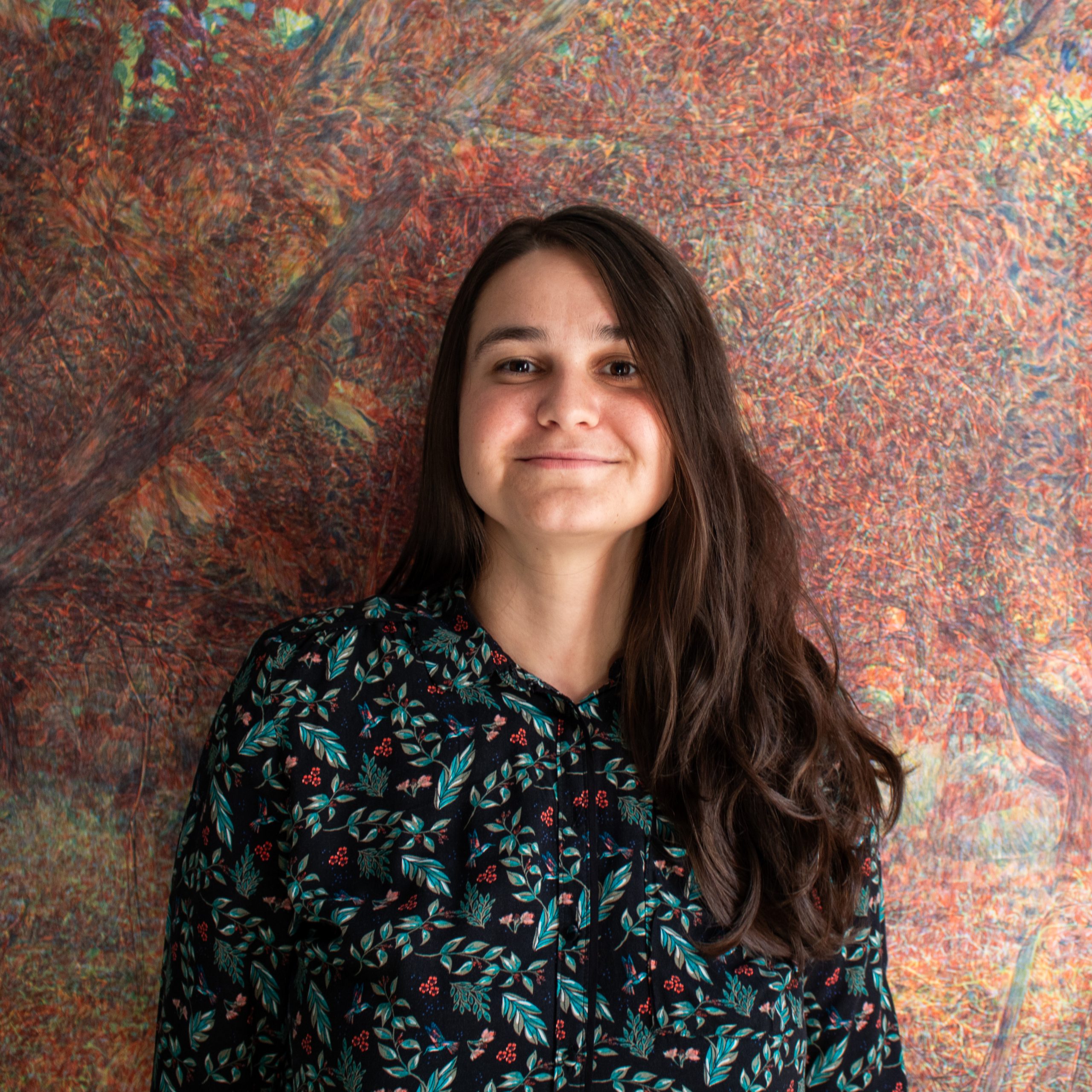
Born in 1996 in Bistrița, Andreea Mihalka graduated from the Faculty of Fine Arts at the University of Art and Design in Cluj-Napoca, Graphics department, with a bachelor’s degree (2018) and a master’s degree (2021). During her studies, she participated in exhibitions and competitions, obtaining the II prize for engraving at the International Print Biennale Bucharest (2016) and the Rembrandt prize at Expo Maraton Cluj-Napoca.
After graduation, her artistic activity continued, as she participated in group and personal exhibitions, including an exhibition in Rome (Spotlighting Cluj, 2021), the annual exhibitions of art teachers from Bistrița-Năsăud county (Master 2022, 2023), and a personal exhibition organized at the Casa cu Lei Bistrita Traditional Art Center.
Interest in the world of art also led Andreea to art pedagogy and research in this field. Thus, in collaboration with university lecturer Dr. Ioana Ancuța Boldiș, Andreea participated in specialized conferences and published two articles in the volumes Current Challenges in Socio-Human Sciences (2023) and ART IN CONTEXT. Best Practices in Teaching Art Online (2022).
Angela Izvercian: Andreea, in your artistic practice, you say that you try to rediscover spirituality and individual meaning in a world dominated by material culture. How are these themes reflected in your work, and what are the main sources of inspiration?
Andreea Mihalka: I think we live in a time when spirituality diversifies its forms and is born in different contexts depending on the individuality of each one. At one point, I wondered if the world we live in is less spiritual, but in the end, I realized that spirituality is still here; only its forms have changed, and it has become more individualized. In my works, I want to relate both to what is spiritual to me and to the spiritual aspects that I observe around me. Searching for spirituality in this world of speed, I have noticed that mundane activities are charged with spiritual meanings. Thus, my sources of inspiration are nothing but torn pieces of everyday life and the “trends” I observe around me.
A.I.: Patience, a virtue increasingly rare in the contemporary world, is a predominant subject in your works. What made you choose this theme, and how do you explore it in your creative process?
A.M.: I think that this subject, patience, is the one that best defines spirituality for me. The sacred is a domain of ritual, of process, of patience. Even though I realized much later, I grew up in a world of patience when people still had time for themselves and others.

A.I.: You work with various techniques, from traditional and digital drawing to engraving and digital print. What do you see as the advantages and challenges of each technique used in the creative process?
A.M.: As for the techniques, I think they choose me. Each technique comes with its own advantages and disadvantages. For example, works made in techniques such as drawing or engraving take a lot of time, which is both good and bad. Works made using digital techniques are cooler for me. This is precisely why the topics covered and the techniques used only work together. If I still relate to things like spirituality and patience, these techniques do nothing but shape my creative process in this regard.
A.I.: In addition to the previous question, I would like to ask you how you think the experience of creating and viewing art changes in the digital age (compared to classical approaches to visual art).
A.M.: I think we now have more means of expressing and propagating art, and we should confidently try the ones that suit us. At the same time, I believe that techniques, be they modern or traditional, are only forms of expression, ways by which man can respond to his creative needs. They change the form and the possibilities of expression, but the creative process and the interaction with art remain human desires, regardless of the techniques.

A.I.: What do you want the viewer to experience/feel/see when they stop in front of a work and gradually discover a multitude of plans and details?
A.M.: I think the answer is partly contained in the question. Most of all, I want the viewer to stop, look and exist in that moment. Because I relate to patience in making the works and my creative process is a test of my own patience, I want the interaction with my works to bring some peace to the audience and ground the viewers in the present. I hope that the layers of work that require deep reading will be an occasion for patience. Otherwise, I am convinced that the works can provoke multiple reactions. As Arthur Danto also says, once it has been completed, the work of art begins its own life, and through the public’s interaction with it, new meanings are born that the creator may not have even thought of.
A.I.: „What you have in the fence says a lot about your personality”, „How many fences, so many dissatisfactions”, or „How many eyes look and how many perceive what the highway of life brings” are some of the titles of your works included in the traveling exhibition “Permanent World Encyclopedia”, co-organized by Arta Prezentului. How do you choose the titles of your works? Is there a working title from the beginning that captures the essence of the work, that imposes a direction until the end, or are there changes as the work takes shape?
A.M.: My works are based on a photographic archive capturing various moments and events. The titles of the works directly reference them; states, feelings, and personal beliefs are described. However, I do not choose the titles from the beginning; they are formed organically as I do the work and realize the full load of the image-source.

A.I.: I confess that the work „How Many Eyes Look and How Many Perceive What Life’s Highway Brings”, a drawing made on a canvas with a surface of 190×140 cm, was one of the most appreciated works in the exhibition. Visitors were fascinated by the thoroughness of the representation and the wealth of detail that is gradually revealed. Please tell us the story of this work.
A.M.: The technique used for the work „How many eyes look and how many perceive what the highway of life brings” is drawing on color layers. I initially started working with layers of color in etching. However, during the pandemic, I no longer had access to an engraving press and looked for new methods to create that type of image. That’s how I arrived at this drawing technique. Initially, I started with small areas until I felt I had mastered the technique well enough to allow me to change the size. I was feeling the effect of this technique on a large surface. Completing the work was indeed a challenge and a test of patience as I worked on it for 8 months.
A.I.: You have won several prizes, including the second prize for engraving at the International Print Biennial Bucharest and the Rembrandt prize at Expo Maraton Cluj-Napoca. How have these awards impacted your career and your creative process?
A.M.: You are confirmed on the right track when you receive appreciation. Those awards made me want to surpass myself. However, thinking coldly throughout my journey, I believe that the intrinsic need for expression is the most important, any external event being only a joy or an obstacle to pass on the path of an artist.

A.I.: Your interest in art pedagogy also led you to research. How does your work as a teacher influence your artistic practice and vice versa?
A.M.: I believe that being a teacher enriches my artistic experience. I have the opportunity to work with students of all ages, from 12 to 18 years old. I can easily observe the stages of the creative process and have contact with one of the purest forms of creativity. These things also keep me engaged and give me energy and desire to work.
A.I.: What projects or ideas would you like to explore next? Do you plan to tackle new themes or experiment with other techniques?
A.M.: The main topics so far, I don’t think I will abandon them anytime soon; they reveal deep concerns that I still have to study and search for. At the level of techniques, new forms of expression can always creep in from the curiosity to discover other ways of transmitting the message. To answer the question more precisely, yes, I plan to experiment with other techniques and have already started. Although they are only in the discovery phase for now, surely different works will emerge soon.