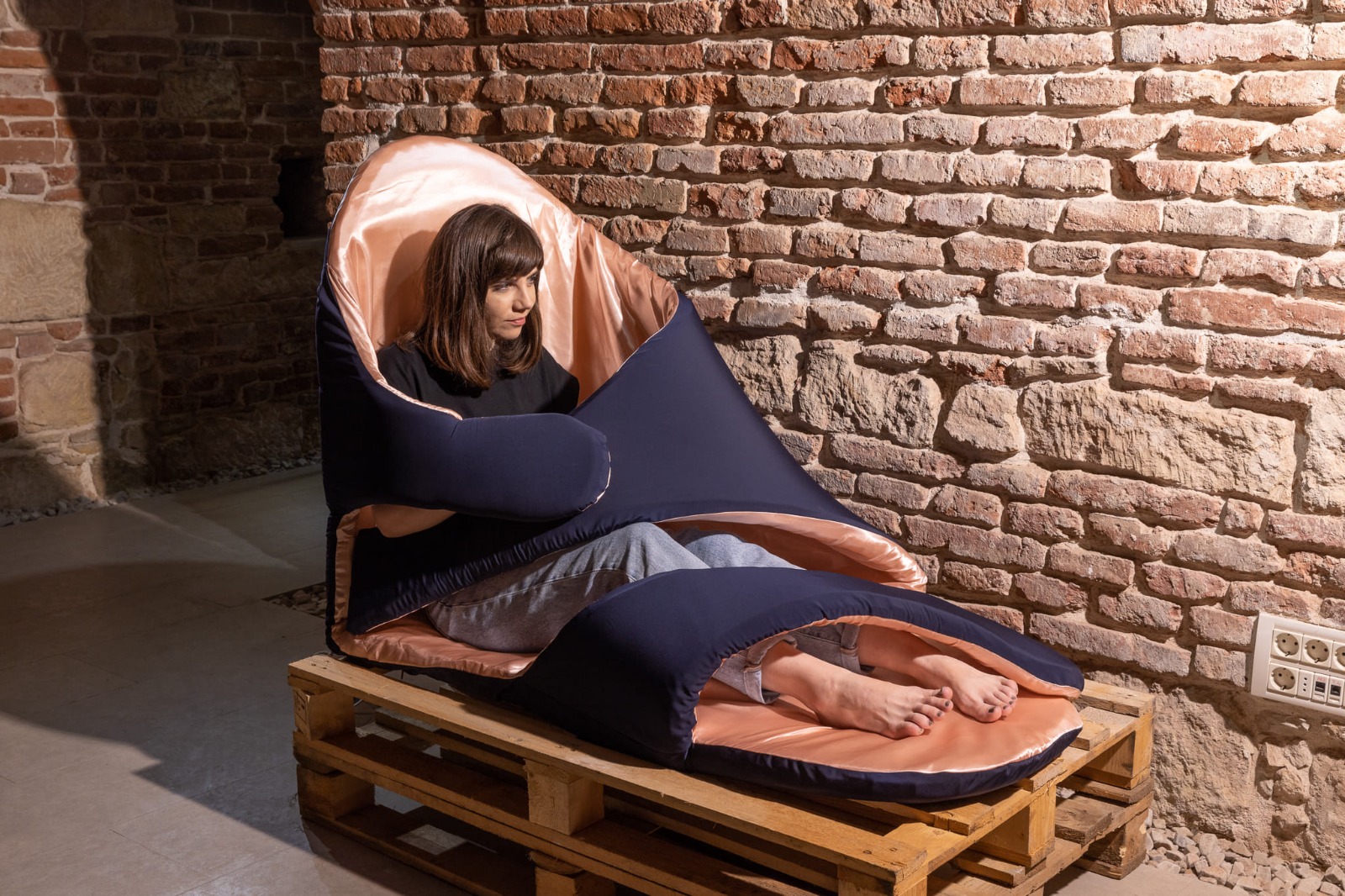
With an artistic journey that moves between drawing, installation, object, and performance, Lucia Ghegu develops an intimate and deeply reflective practice in which materials become extensions of emotion and visual thought. Oscillating between fragility and strength, between the need for closeness and the fear of exposure, her works create spaces of encounter between bodies, ideas, and perceptions.
The artist explores recurring themes such as vulnerability, intimacy, and the tension between attraction and danger, offering the audience not merely objects or installations, but genuine sensory and conceptual experiences.
In this interview, Lucia speaks about the way she experiments with forms and materials, about the influences that have shaped her path, and about how art can embrace where words can no longer reach.
Ada Muntean: How did your relationship with visual art begin? Was there a defining moment, or was it a natural, gradual process?
Lucia Ghegu: My relationship with visual art developed gradually, naturally, and instinctively—as a need to create with my own hands. My academic background is relevant to this long process, as I moved between engineering, art, and design, and in time I understood that art is not a choice—it is a way of being, a primary need.
A.M.: How would you describe your artistic practice? What draws you to the visual media you use?
L.G.: My practice focuses on the relationship between body, object, and space, combining installation, object, drawing, and representations of the body. Drawing plays a central role—it is a space for visual thinking, where I explore and project ideas. The choice of medium or material is always subordinate to the concept I pursue, yet the result is often influenced by practical constraints—financial, spatial, or logistical—which in turn become part of the creative process itself.

A.M.: You move between several visual media—installation, drawing, object, performance. How do you connect the concept behind a work with its final formal outcome?
L.G.: Each material is chosen to reflect the concept of the work. For a Hugging Device, I use soft, textile materials to evoke a sense of intimacy and safety, whereas for a trap I use industrial, solid materials and appealing colors, making them seem secure and seductive despite their inherent danger. The material thus becomes an integral part of the experience, communicating the conceptual intention directly through tactility and perception.
A.M.: What role does experimentation play in your artistic practice?
L.G.: Experimentation is part of my working process—more like a game in which I set and adjust the rules. In the studio, I explore forms, gestures, and interactions through sketches and models; I often work in series that evolve together, and my process remains fluid and intuitive.
A.M.: Which artists, experiences, or places have most influenced your artistic formation?
L.G.: My influences come more from a mix of experiences, encounters, and observations rather than from a clearly defined group of artists. I remember very well the first time I saw Bosch’s The Garden of Earthly Delights on television and how much I wished I had been Bosch — or Botticelli, painting Primavera. Over time, I realized that painting influences me the most, even though I don’t practice it at all — including contemporary painting.
As for places, Rome was extremely important, especially during my residency at the Accademia di Romania. The master’s program in industrial design at the Polytechnic University also had a strong impact — it helped me understand more clearly what kind of art I want and am able to create.

A.M.: Are there recurring themes that consistently appear in your works?
L.G.: Yes. My works explore vulnerability, fragility, and the relationship with the body—either through structures that invite participation or through objects that test the limits of perception. Play, balance, and the tension between attraction and caution, between expectation and reality, and contradictions appear constantly, turning the experience into a reflective act. My works gradually transform into one another, and sometimes I have the feeling that everything is part of the same piece. The transition from one theme to another is very subtle, almost imperceptible, like a continuous thread connecting them.
A.M.: How do you see the relationship between intimacy and exposure in contemporary art?
L.G.: I believe that intimacy and exposure inevitably coexist in contemporary art, though not necessarily as opposites. For me, intimacy doesn’t necessarily mean confession, but rather a form of openness—toward one’s own limits, the body, space, and others. Exposure occurs when this openness becomes visible, when the work creates a context in which the viewer also feels involved or vulnerable.
I like the idea that a work can be deeply personal without being autobiographical, and that emotion can be conveyed through form, material, or installation—not only through declared content.
A.M.: Did your participation in “Breaking the Silence: A Visual Narrative on Emotions Left Unspoken” change the way you relate to vulnerability in art?
L.G.: My participation in Breaking the Silence: A Visual Narrative on Emotions Left Unspoken aligned very naturally with the way I already work. I’ve been interested for a long time in vulnerability and in how it can be conveyed through a physical situation. My works often involve the active participation of the audience and create contexts of exposure, closeness, or discomfort. In this sense, the hugging devices have become an interface between the need for contact and the fear of it.
A.M.: In your artistic intervention within the exhibition, how did you choose to visually “translate” silence?
L.G.: My works weren’t conceived specifically for the theme of silence, but I think silence and solitude are inherently present in them. In Hugging Device and GP System, closeness is always mediated by a device that limits contact, and the space between bodies generates this sense of silence. It’s a silence that doesn’t signify absence, but rather the impossibility of complete communication—and the solitude we carry even when we are close to others.
The interview was conducted as part of the cultural project “Breaking the Silence: A Visual Narrative on Emotions Left Unspoken”, co-financed by the Administration of the National Cultural Fund (AFCN). The project does not necessarily represent the official position of the Administration of the National Cultural Fund. AFCN shall not be held liable for the project’s content or any use to which the project outcome might be put. These are the sole responsibility of the beneficiary of the funding.