An interview by Andrei Bucureci
Maria Balabaș is a multidisciplinary artist who studied musicology at the National University of Music in Bucharest and is currently a PhD candidate at CESI (Center of Excellence in Image Studies), where she is developing a project on multiple ways of listening to recent history.
Maria has hosted Dimineața Crossover on Radio România Cultural for over a decade and has created innovative projects such as “Raised to Be Free. Stories from Central and Eastern Europe” or Veneticii. Her radio creations have been nominated for prestigious awards like Prix Europa, Prix Italia and Grand Prix Nova.
In parallel, she works as a multimedia artist, with her creations featured in national and international festivals and exhibitions. Together with German artist Alexander Arpeggio, she is preparing to release Rural Rhythms, an independent production she has been working on for seven years.
Her project Radio Vis brings sound art to rural areas in a world where cities concentrate most cultural resources. We spoke with Maria Balabaș, co-founder of Asociația Minimorum, about how a dream can become a real channel of expression for children from disadvantaged areas.
Andrei Bucureci: Maria, we first met during the urban field recordings walks you organized with Sâmbăta Sonoră. What memories do you have from that time and how did they influence your artistic journey?
Maria Balabaș: Ah, sound walks and field recordings are still part of my artistic practice, and in fact they became the foundation for the doctoral thesis I’m working on. This practice of listening, of being sensitive to the connections created with certain places, helped me in the period when I wasn’t sure if living in the countryside was the right choice. I spent hours listening to the garden, the barn, the village, and was lucky enough for some of these “listening” sessions to become new sound creations for initiatives like Semi Silent or the Center for Visual Studies.
A.B.: I also listen with pleasure to your radio show and try to discover new pieces in your playlists. What are your favorite moments from Dimineața Crossover, which you’ve been doing for over a decade?
M.B.: Morning still helps me live a better life personally. And, to extend the answer, it seems to have a similar effect on many others. It’s a broad community of people who understand they belong to a certain musical language, a common vocabulary grown together over time. After so many years, waking up and thinking about music instead of something else creates balance—an intergenerational one. I like saying “Good morning” and imagining countless lives tuning into this shared space. I think of the shows as extended walks through music history. And I also love the moments when I meet listeners of Dimineața and their faces light up when they hear my name; their joy is proof that our work (I’m with George Gîlea on the team) actually reaches its destination.
A.B.: What personal, artistic or professional influences shaped the interdisciplinary direction of Minimorum NGO?
M.B.: The first essential influence is my husband, Vlad Mihăescu, an environmental ethics researcher who lives by his ideas and concepts. It was difficult for me to adapt to his lifestyle and to a form of honesty that involves constant inner work and expressing it to yourself and to others. The association’s name was inspired by the minimalist lifestyle he embraced, and by the idea that you can do a lot with very little. Building on that philosophical beginning, we created Minimorum’s current projects based on my own experience and interests as an artist, researcher, and journalist. I gave myself years of freedom to explore different artistic mediums. Rural life added the need for educational initiatives. This interdisciplinary format is thus both a product of our professional and vocational experiences and a response to the needs we see in the world we’ve chosen to live in.
A.B.: How did the idea for Radio Vis appear, and how is it linked to your radio and sound art experience?
M.B.: During the pandemic, wondering what I could do in the village, I started gathering children to read in our barn. The pandemic caused damage but also gave us time we couldn’t have imagined otherwise. I spent hours listening to recordings with the kids. Out of that open-ended work, which I was doing to save myself from pandemic anxiety, the idea of a larger project emerged. That became Radio Vis.
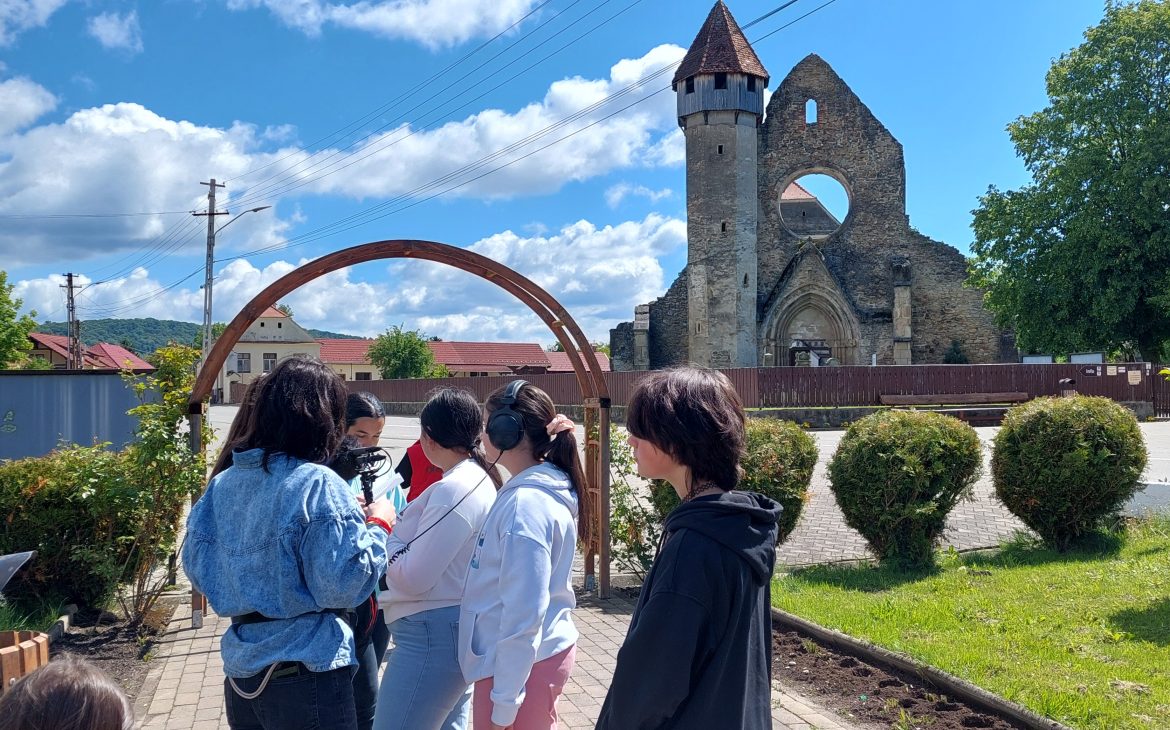
A.B.: In the project you say the children are “co-creators.” What does that mean in practice, and how does it change the educational and artistic dynamic?
M.B.: I’ve struggled with the objectification of children, presenting them only in contexts that mirror adult worlds, not theirs. Listening to recordings of the village children revealed an enormous richness in the way they speak or make connections. We wanted Radio Vis to be about that phenomenological meeting between adult ideas and children’s worlds, without one trying to convince the other it’s “better.” Sound is a medium perfectly suited for this closeness, turning children instantly into actors or writers—even if some can’t write. In sound they write with their presence, their stories, emotions, sighs, impatience. All of it becomes part of the text. By listening to children this way, they become “co-creators.”
A.B.: Who are the artists and facilitators who worked with you on Radio Vis?
M.B.: I collaborated wonderfully with writer Adina Popescu, who created film-like scenarios with the kids and opened up worlds usually banned at school—casinos, gangsters, corrupt cops. Boys who initially looked at us with suspicion became deeply involved actors in roles they created themselves. Another key presence is French artist Marie Guerin, who drew the children out of the classroom to collect stories and turn the village into a land of all possibilities. Director Irina Gâdiuță and actresses Irina Artenii and Carmen Lopăzan continued exploring the children’s imagination with games that sparked surprising results. Mihai Balabaș made music with the children from Cârța and Bruiu, capturing the emotion of hearing themselves on microphone and composing songs. Anamaria Pravicencu will design a small book synthesizing project ideas and sending them into the world.
A.B.: How did the collaboration with Mircea Pop unfold?
M.B.: I had worked with Mircea on the book Urmuz. Pagini bizare published by Editura Art. His illustrations were a benchmark for me, so when we began Minimorum projects, I immediately thought of inviting him. His illustration for Radio Vis—a living radio sprouting dancing plants—is extraordinarily subtle and inspiring. It set the tone for the project. I still can’t believe Mircea has passed away. We met too little in real life, but our artistic encounter holds immense value for me.
A.B.: What challenges did you face in making Radio Vis (co-funded by AFCN) and how did your prior experience help overcome them?
M.B.: Radio Vis is exploratory, and the children’s imaginations often surprised us. Some initial ideas didn’t work out, so we adapted and learned to open real communication spaces. Radio and art—as media that demand openness and presence—helped me adjust my language and imagination to meet the children. All collaborators built the same premise of equality in dialogue.
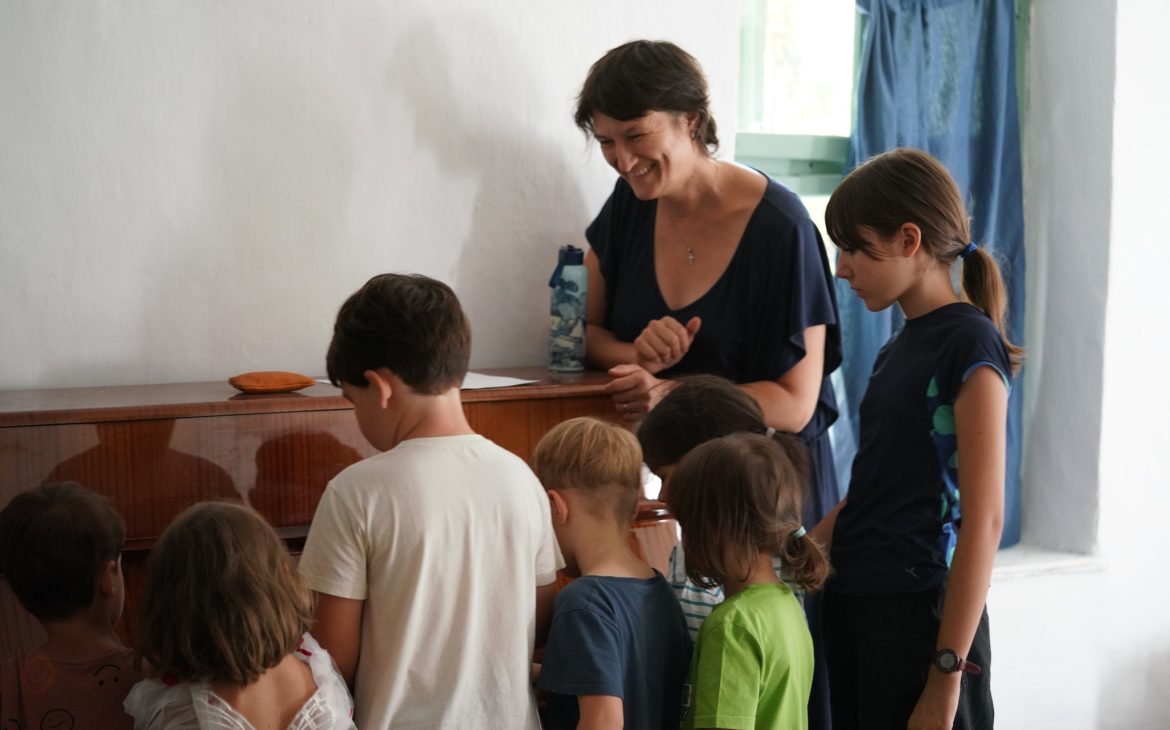
A.B.: How do you imagine the long-term evolution of Radio Vis and the role of Asociația Minimorum in Romania’s cultural landscape?
M.B.: I hope Radio Vis continues its exploratory spirit and speaks to children about the richness of sound surrounding us, showing them they matter no matter how far from “important” places they are. I imagine Radio Vis will help bring sound art, radio journalism, and radio theater closer to children everywhere. Minimorum’s mission is to expand communication, reciprocity, and create bridges between urban and rural worlds, responding to current and long-term challenges in access to education, resources, and social recognition.
A.B.: Could you give us a Radio Vis playlist—a dreamlike sound journey with the children?
M.B.: Rather than a playlist, I’ll describe the soundscape: muffled laughter, scraping chairs, church bells, tractors, voices. Children sing songs, tell dreams about horse farms or being Messi, blow whistles, fill hallways with ceramic bird trills. We sing in the Cistercian Monastery and in the Bruiu schoolyard. An elderly woman says no one has visited her for years but she likes people. Small Sonia tells me in her deep voice that “school is nicer than home.”
A.B.: If Radio Vis could be reduced to one sound, what would it be?
M.B.: Don’t ask me to do that, please. There are too many. 🙂 I’d rather say the most moving part is the intention behind the sounds—the children’s need to be heard as they are.
A.B.: Which artistic or cultural influences guide your music and sound creation?
M.B.: Right now I’m reading extensively about listening—Hildegard Westerkamp, Abigail Gardner, Gascia Ouzunian, Jacek Smolicki, Elena Biserna, Brandon LaBelle, Jean Luc Nancy, Rebecca Solnit. Reading about music therapy has deepened my sense of equality in the sound space, where artist and audience co-create meaning and sonority.
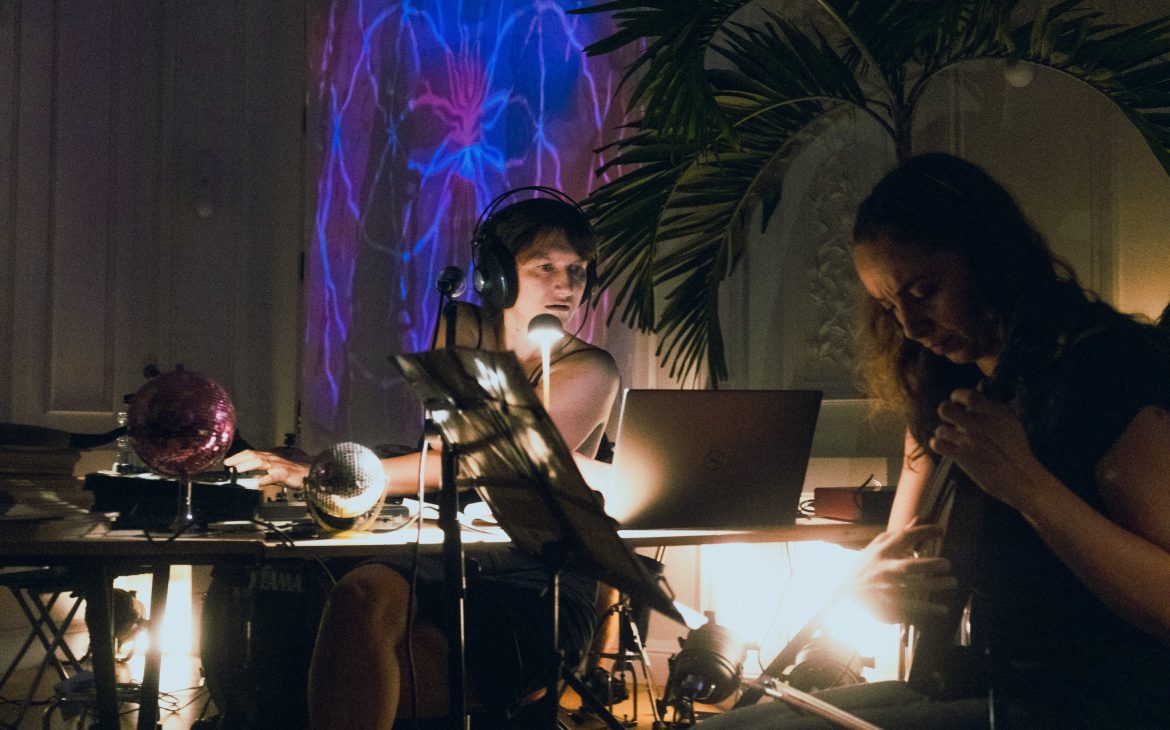
A.B.: What are the components of the Radio Vis installation and how will it be interactive?
M.B.: As with every project, unpredictability is part of it. During a hospital stay with our son, I imagined a radio in every pediatric ward playing only stories on its frequencies. Programmer Andrei Diea built a prototype of such a modified radio, and now he’s making one for Radio Vis where we control the audio content. The public can switch frequencies as on a normal radio, creating live collages of the children’s stories. Director and scenographer Irina Gâdiuță is also creating a radio play inspired by our recordings to broadcast on “classic” radio.
A.B.: You’ve been nominated for international competitions like Prix Europa and Prix Italia. What did those recognitions mean to you?
M.B.: Competitions show you your real level. For me, the nominations confirmed there’s value in my work but also showed how much more I have to learn and what resources I’d need in the future. One dream is for Radio Vis to reach an international competition like that.
A.B.: One of your constant collaborators is your brother, Mihai Balabaș. What childhood memories do you share that connect to music?
M.B.: If you asked him, he’d recall sitting under the piano while I practiced scales. He often says his ear was trained then. I remember listening to records on a turntable—the feeling that each voice was a world, from opera choruses to Nicolae Herlea to Vara la țară by Mircea Baniciu or Play the Game by Queen. My father’s stories about bands he couldn’t access under communism also shaped me. Perhaps that’s why my sound world oscillates between reality and imagination.
A.B.: Your album Avant’n’Gard contains a striking reinterpretation of “Ioane, Ioane.” How did that version come about?
M.B.: I discovered it on the Ethnophonie collection coordinated by Speranța Rădulescu. The singer’s voice, the melody—both cry and descent into ungraspable sadness—spoke to me. I tried to find my own voice within it. My colleagues embraced this and during recording we felt a rare harmony. Folklore remains essential to my music, with Colinde Netemperate as a full album inspired by caroling traditions.
A.B.: Another fascinating project is Soare Staniol, where you reinterpreted songs from Methadon 3000 feat. Deceneu to CAN. How did this album arise and what did you discover during its promotion?
M.B.: Soare Staniol was years of work—sound construction, musical selection, each cover with its own story. Unfortunately the album was released at the start of the pandemic and we couldn’t take it on stage. Time passed, Radio Vis emerged, and Soare Staniol still waits for its live moment.