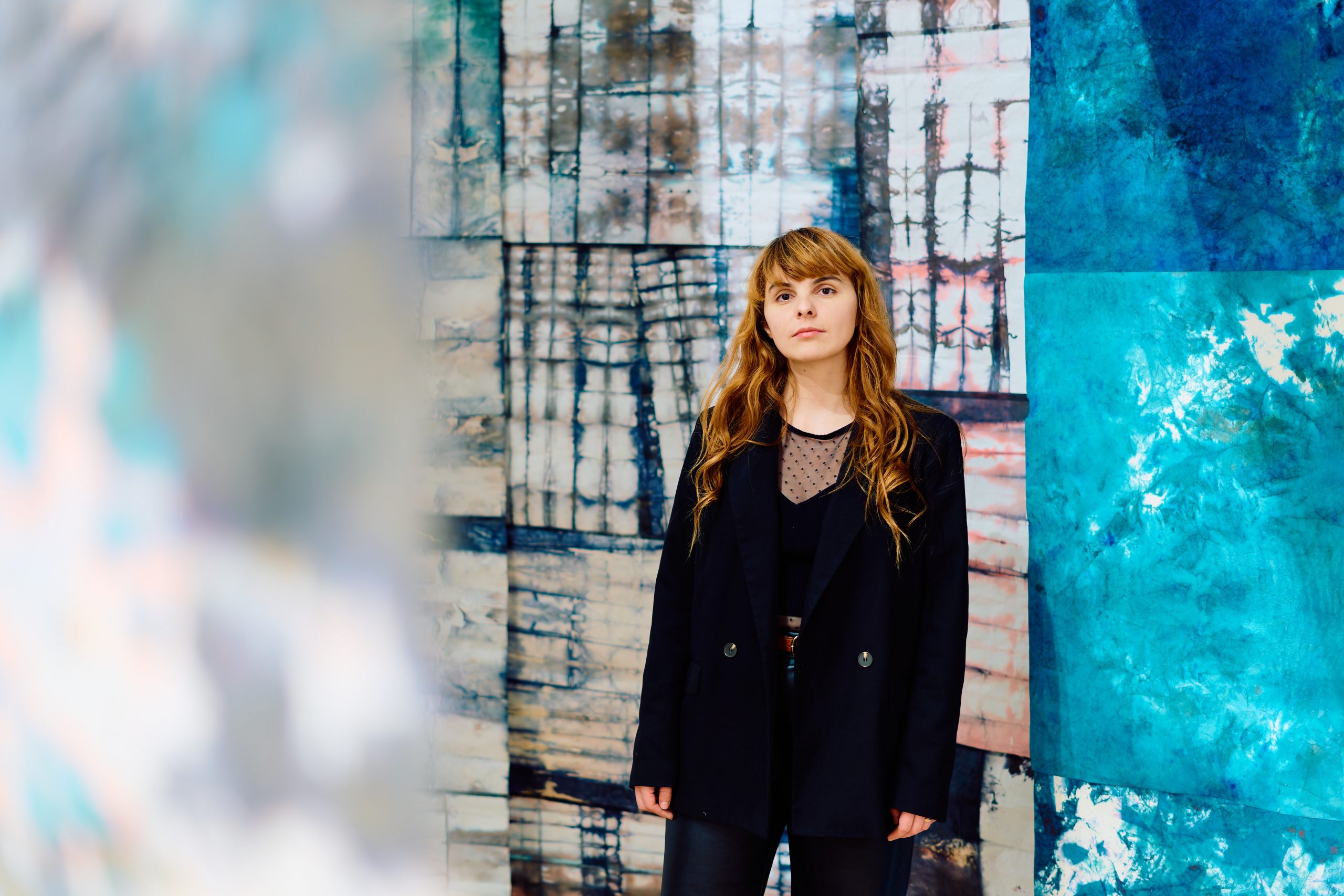
At a time when textile art is firmly claiming more and more of its place in the contemporary discourse, Tina Chiriță’s practice stands as a compelling example of how material can be a carrier of meaning, memory and emotion. An artist and designer based in Cluj-Napoca, Tina Chiriță explores the textile universe not merely as an aesthetic field, but as a space for reflection on the relationship between humans, matter, and perception. For her, fiber, texture, and color are not just simple artistic tools, but elements of a living language, capable of constructing visual and tactile narratives with conceptual depth.
The central argument of her artistic approach lies in the belief that textile material possesses its own expressiveness, one that transcends functionality and decorative purpose. By combining traditional techniques with experimental approaches, Tina Chiriță succeeds to transform the process of creation into a form of introspection—a mediation between gesture, surface, and meaning. Her practice thus becomes a dialogue between fragility and durability, between presence and absence, and between the viewer and the object that’s inviting them to a sensory and emotional experience.
In an artistic context where the interaction between materiality and perception is increasingly relevant, Tina Chiriță proposes a vision in which textiles are no longer only aids, but mediums for thinking and feeling. Through her works—exhibited both in Romania and on international stages—she redefines the boundaries of textile art and brings back into focus an essential question: how can the material, with its fragility, become an authentic channel of communication between the artist and the viewer?
Ada Muntean: How did your relationship with textiles begin and what role did studying at the University of Art and Design in Cluj-Napoca play in shaping your artistic direction?
Tina Chiriță: Textiles have always been a part of my life. My mother worked in garment production and used to weave dishcloths at home from leftover fabrics—I remember how she involved me in that, without me realizing at the time how much this closeness to material would influence me. However, I only began using textiles as a mean of expression during my undergraduate studies, when I discovered that I was more drawn to the material’s expressiveness than to clothing forms. I then pursued a Master’s in Textile Design, where I had the freedom to experiment and learn to communicate through material, technique, and gesture. My training at UAD was essential—I had professors who encouraged me to explore and define my own visual language. Later, through my activity in the university, working with students gave me the opportunity to refine my techniques, but also to constantly discover new perspectives. I believe this continuous dialogue between practice, research, and learning is what defines me even today.
A.M.: You describe your working process as being “intuitive.” How does intuition articulate with technical rigour in your practice?
T.C.: For me, intuition and technical rigor are not mutually exclusive; rather, they complement each other. Intuition appears at the beginning, when I choose the material or start an intervention without a clear plan, allowing myself to be guided by the material’s reactions. Then technical rigor comes into play, giving shape and coherence to intuition.
A.M.: What role does “gesture” play in your works? Is it more of a spontaneous expression or a controlled, deliberate one?
T.C.: Gesture plays a very important role in my work, serving as a way to record presence, emotion, and the time spent with the material. Sometimes it is spontaneous, other times it becomes deliberate, repeated, almost ritualistic. I believe there is a balance between the two: the spontaneous gesture brings authenticity, while the controlled one provides meaning and structure to the entire process.
A.M.: What does it mean to you for a work to “have a body” but also to create the desire for touch on the part of the viewer? What visual or tactile elements do you think stimulate this interaction?
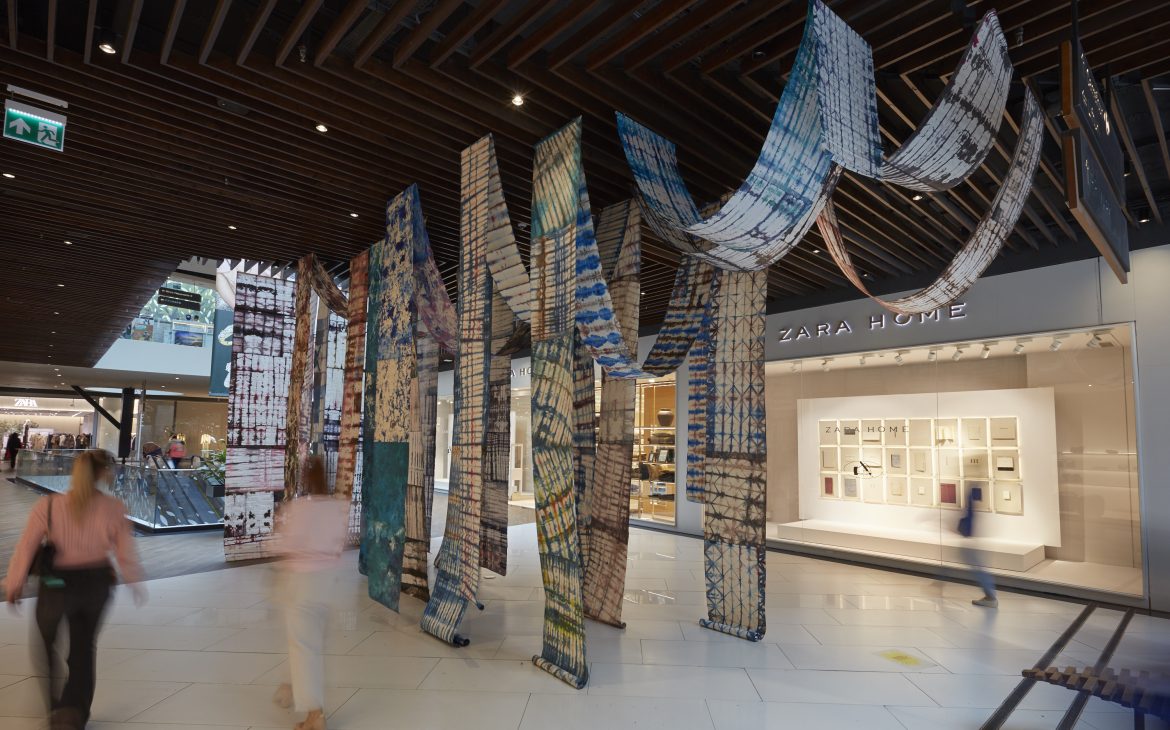
T.C.: For me, for a work to “have a body” means for it to be present and tangible in the space, to occupy volume, to have a physical presence that can be felt even before being touched. I am not necessarily referring to human corporeality or to how a textile fits on the body, but rather to the way the material, its form, and texture can influence the viewer’s perception and their relationship with the space. I admit that I rely on the fact that the materials I work with have a strong connection to the instinct of touch — touch arises naturally, almost intuitively. The desire to touch comes both from the sensitivity and fragility of the material and from the idea that touch is a fundamental way of obtaining knowledge. The viewer is thus invited to explore the structure, texture, and energy of the work through tactile engagement, turning the interaction into an active dialogue with both the material and the space.
A.M.: To what extent do the natural environment or nature-related experiences contribute to the structure and meaning of your works?
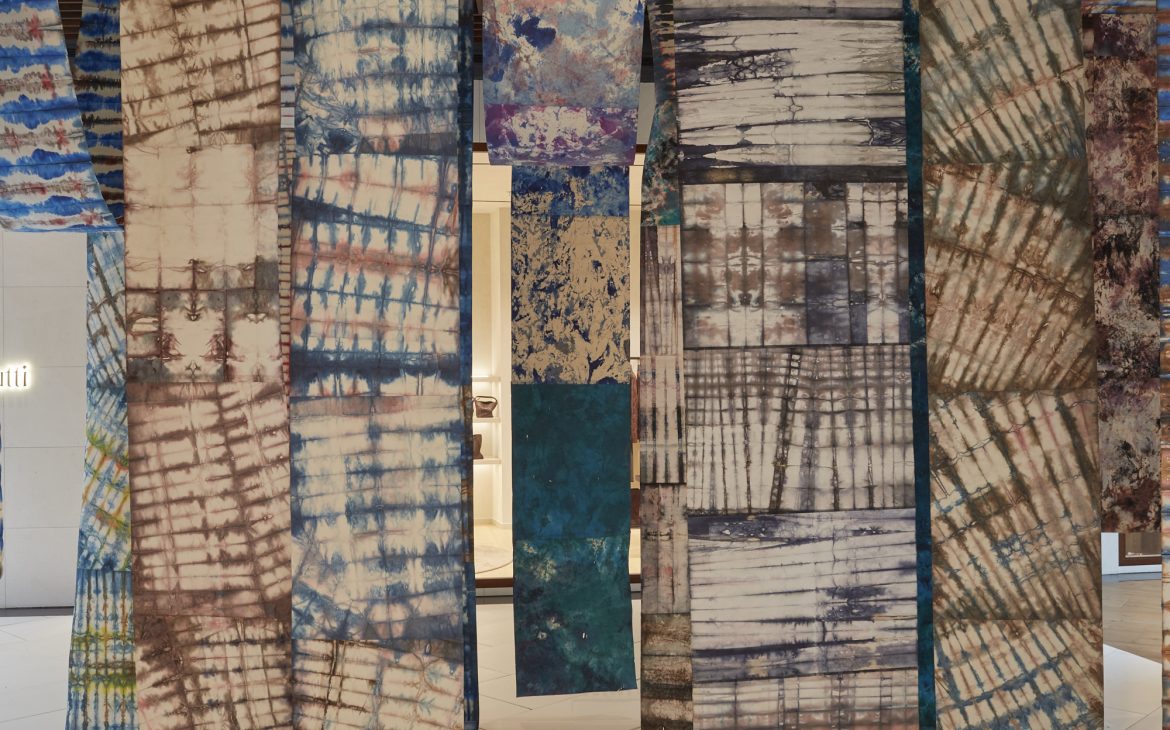
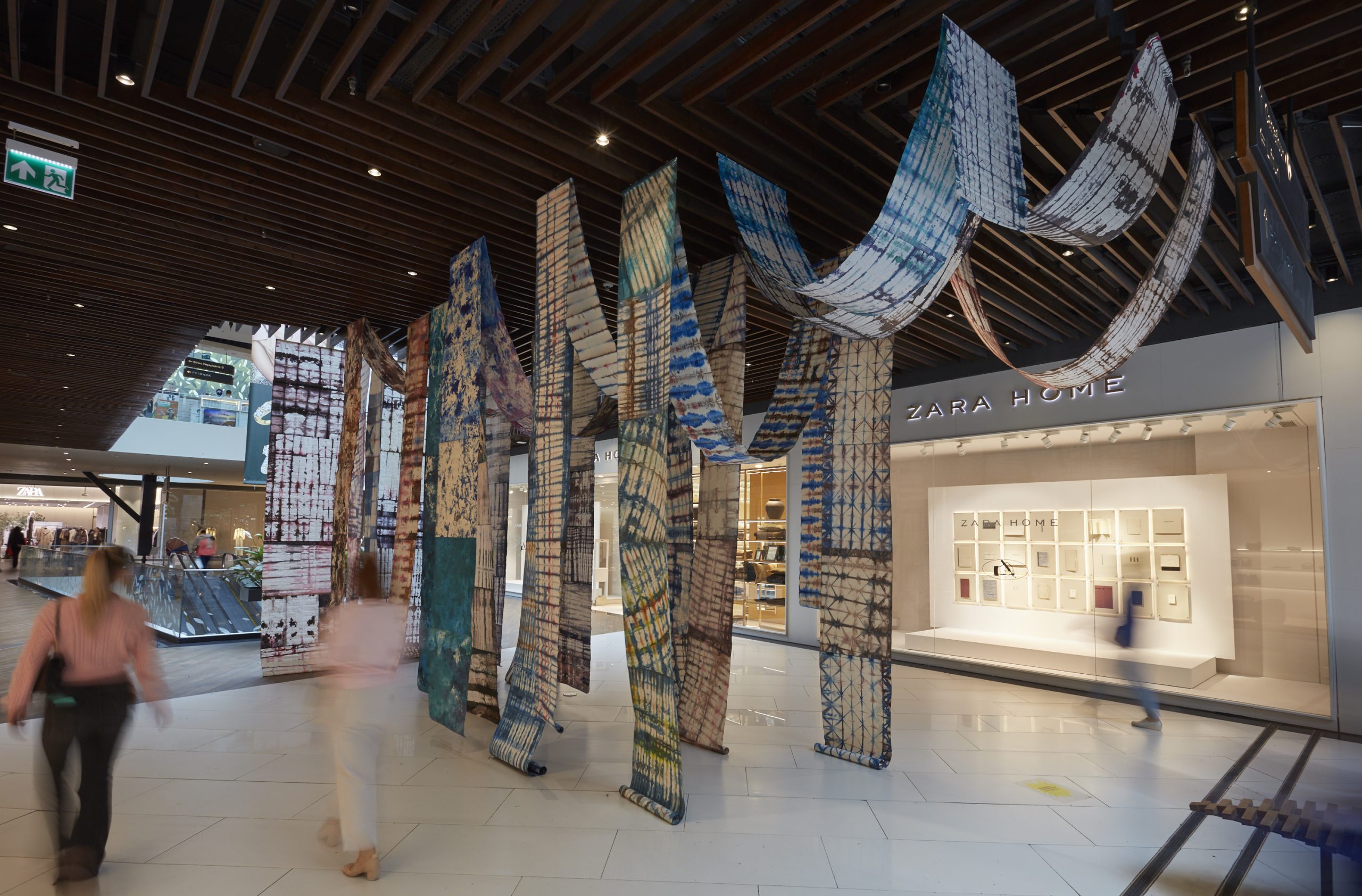
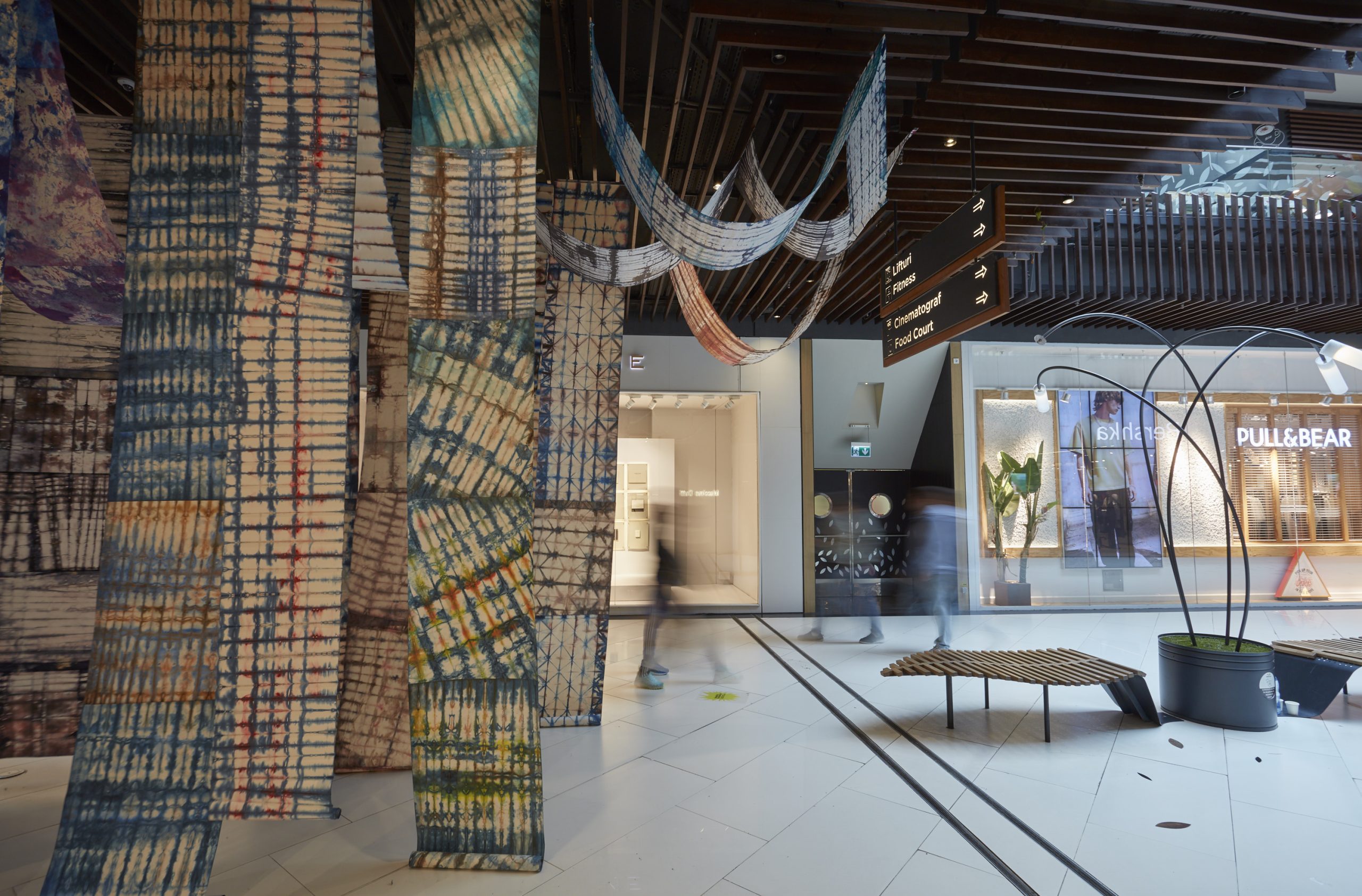
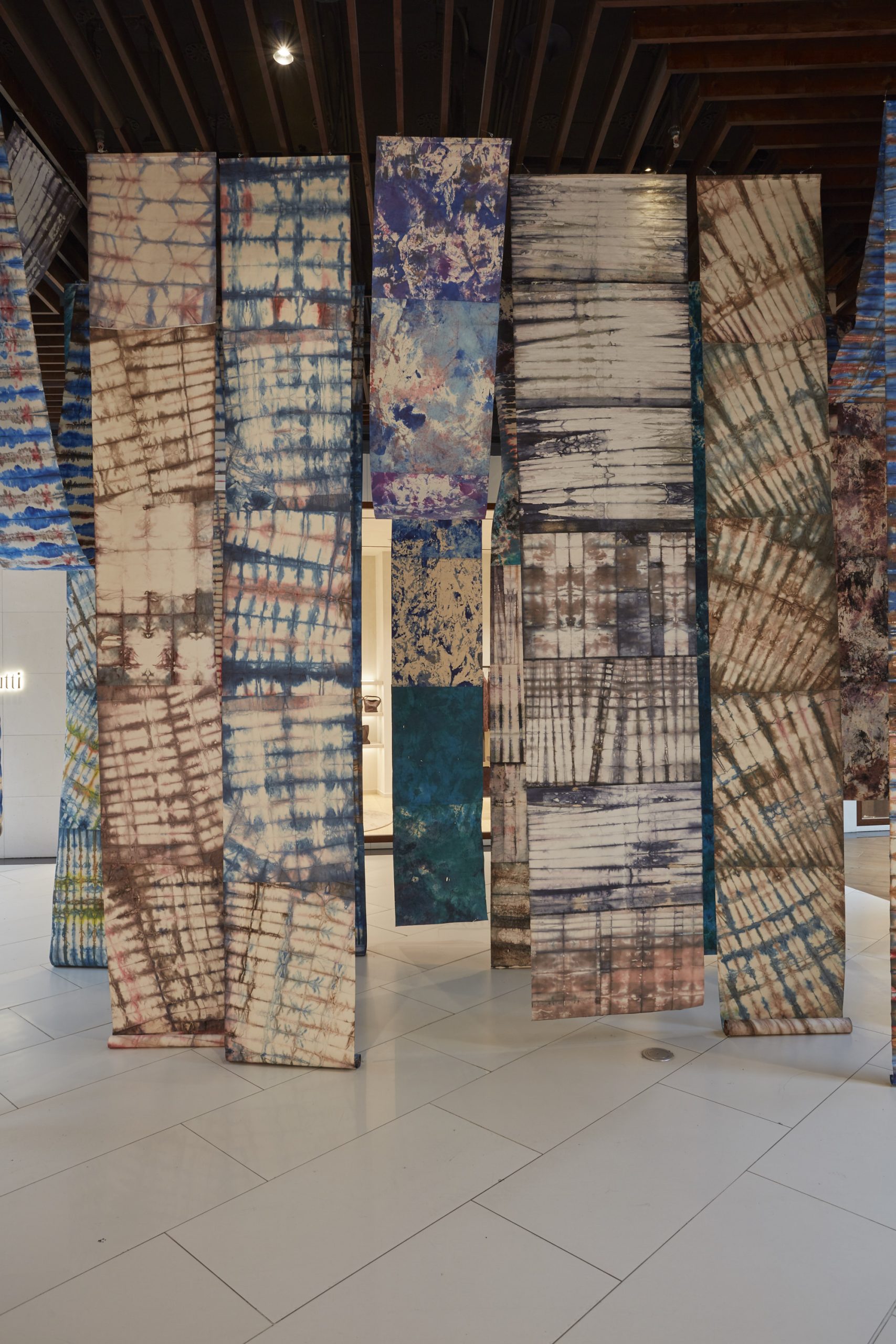
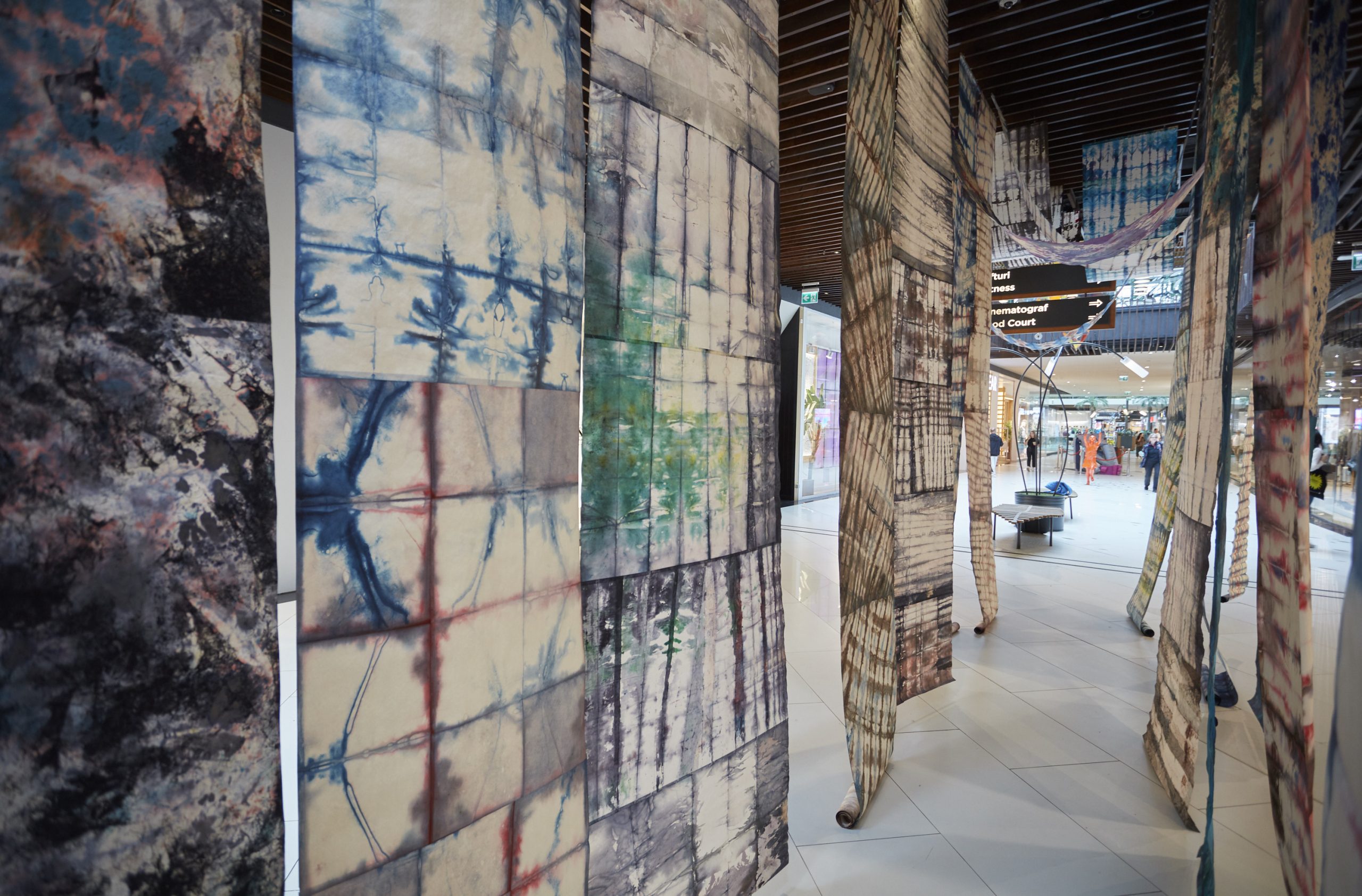
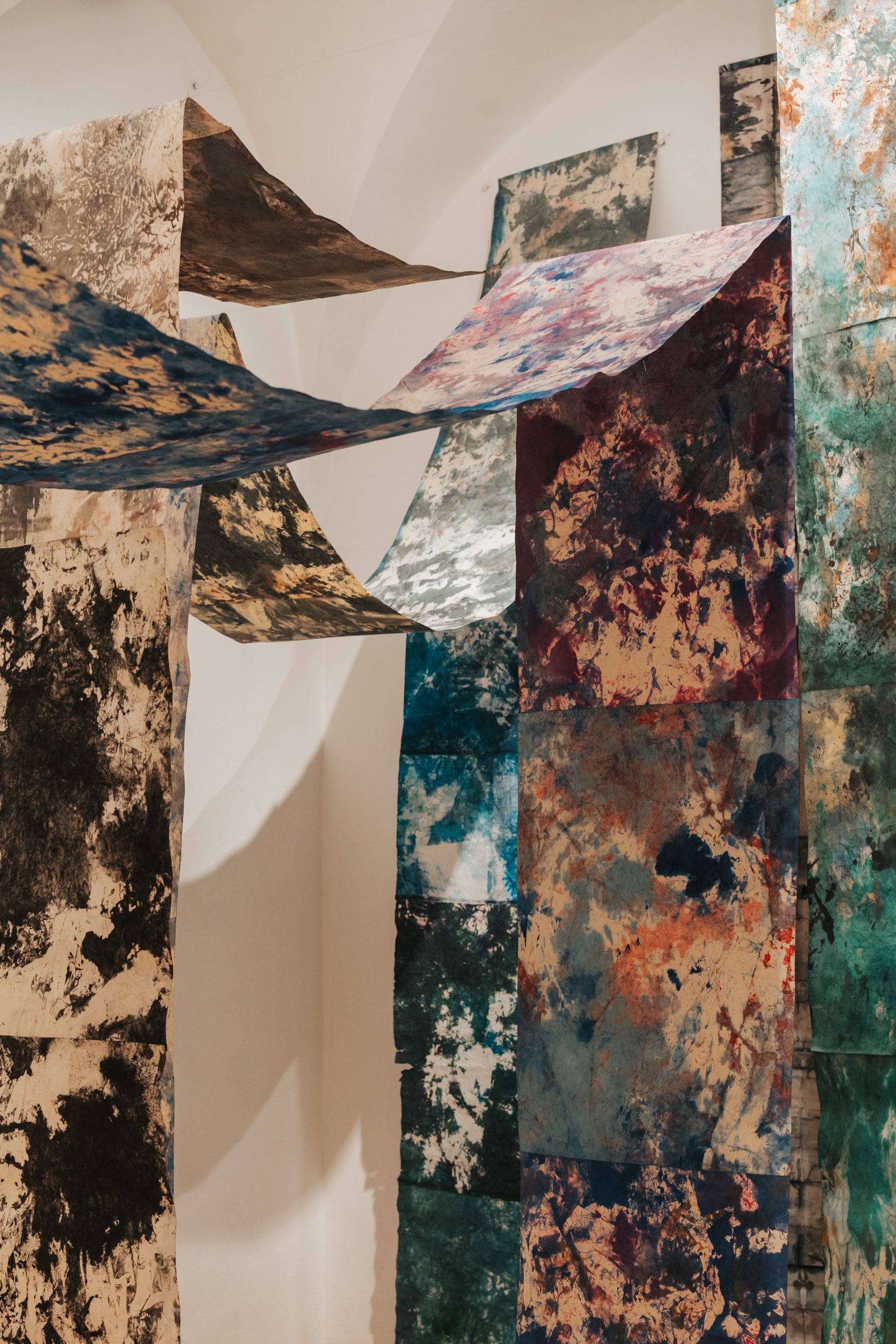
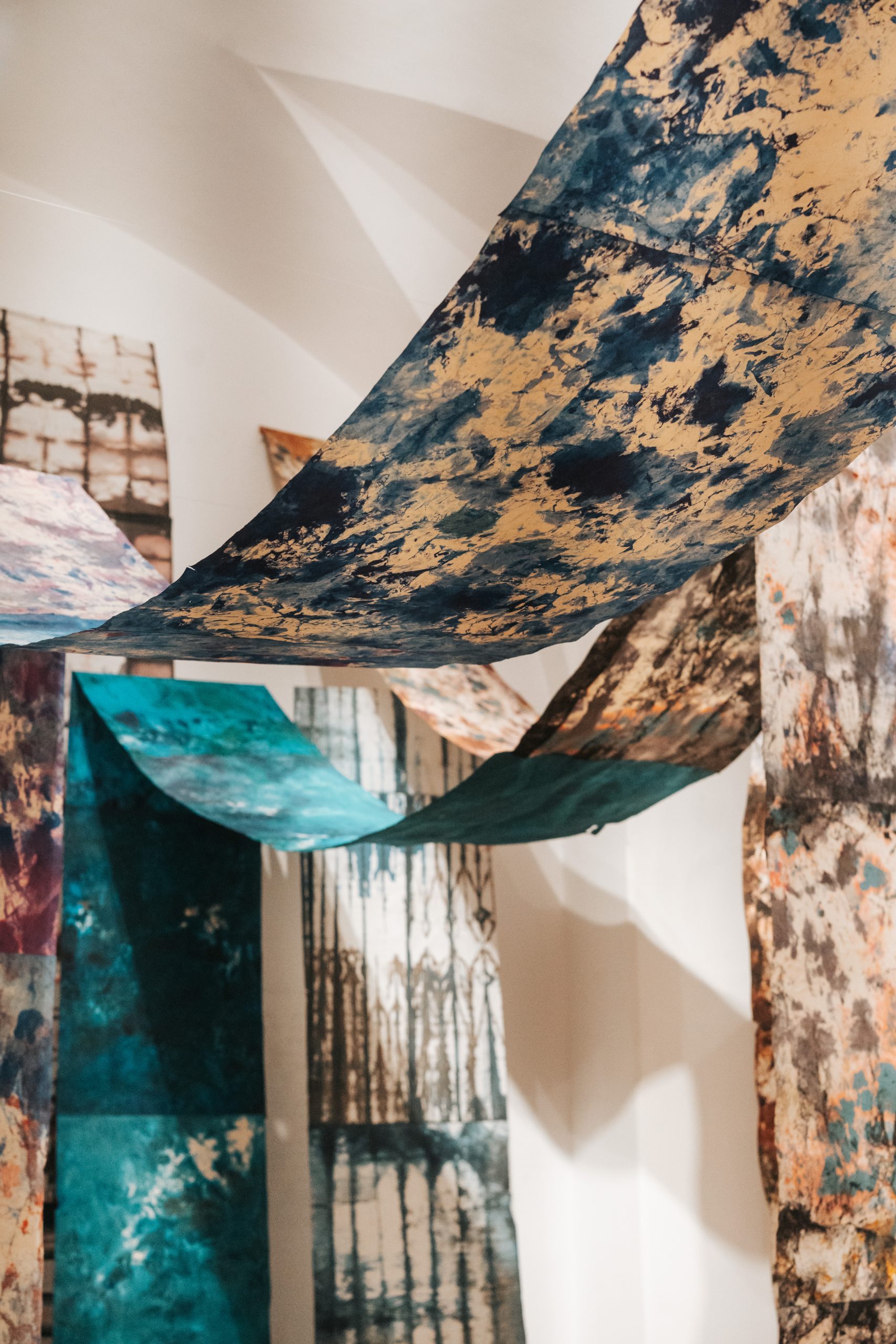
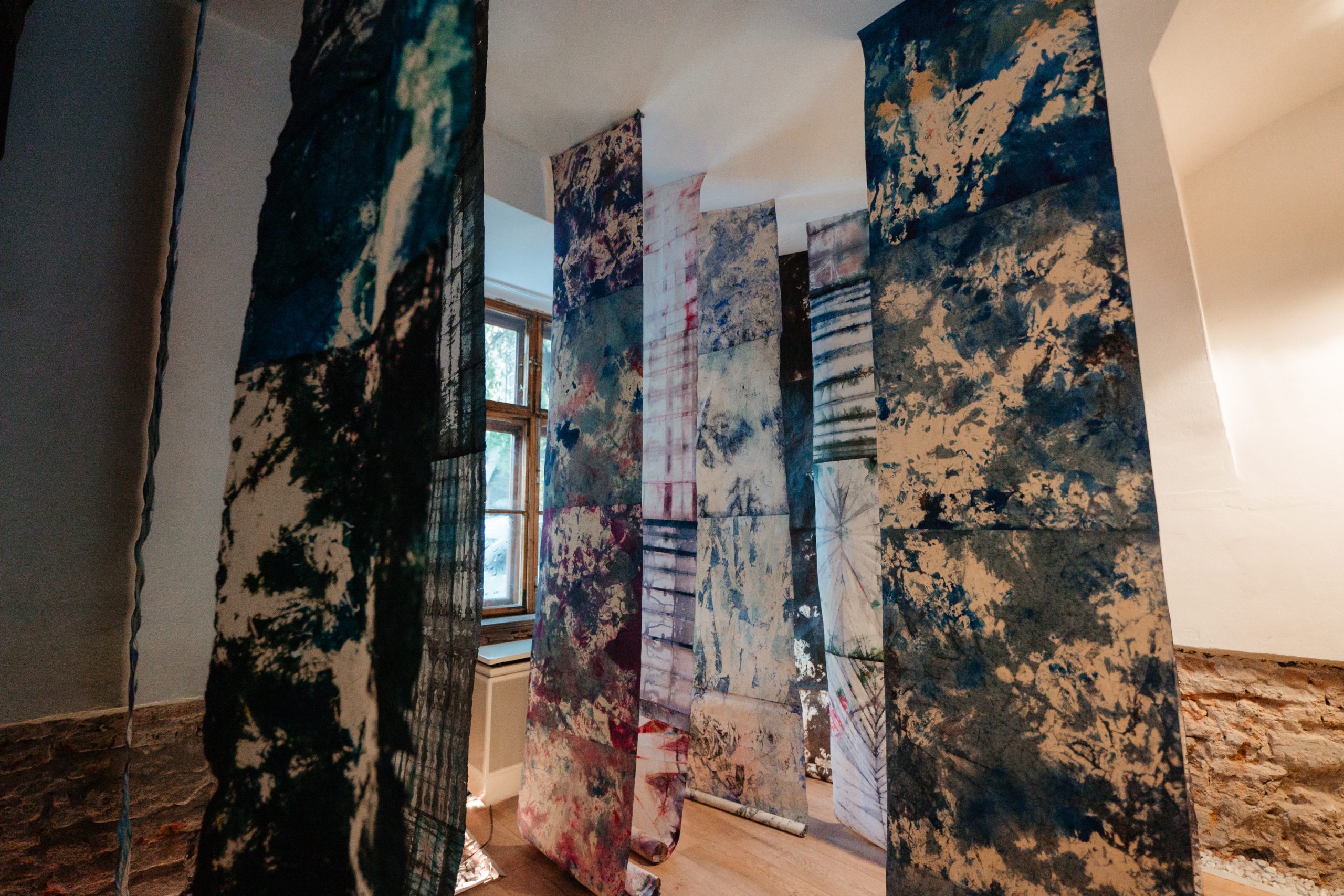
T.C.: The natural environment plays an essential role in my works, and I often explore natural stimuli — the air that sets materials in motion, the light that shifts perspectives, or the shadows that transform them. Throughout the whole “INDIGO” series, these elements turned the work into an interactive object. Likewise, in the collective installation “FLUID” (presented at the “Iarmaroc la Sat” festival — authors: Tina Chiriță, Bianca Balaban, Larisa Petcuț, Ema Măhălean — partner: IARMAROC.com), air movement and interaction with nature were crucial to the way the audience perceived the works. I want to continue this exploration, because the textile material has an extraordinary potential to connect with natural phenomena and to generate complex and intimate sensory experiences.
A.M.: You often talk about the “expressiveness of textiles materials.” How do you choose the right materials for a work?
T.C.: The choice of materials I work with is closely connected to my artistic intention, yet textile materials and those with a textile expression remain the central focus. Beyond that, in my works, technique becomes more than execution; it becomes a language through which the material, the gesture, and the concept communicate.
A.M.: How do you explore the sensory and emotional side of textiles in relation to your working process and last but not least in the interaction with the viewer?
T.C.: The greatest challenges arise from my relationship with the material — I am constantly seeking to discover how it responds to gesture, how it reacts to the process (the technique), or how it can convey the idea or emotion I’m pursuing. Through experimentation, I’ve learned that every material has its own behavior, and I must learn how to manipulate it, how to use it. The constant challenge is to make the material expressive, capable of generating interaction without losing the conceptual intention.
A.M.: Looking to the future, what themes or possible projects do you set out to materialize?
T.C.: At the moment, I am searching for a balance between motherhood and my artistic practice, after a long pause during which I wasn’t able to fully concentrate on my personal conceptual work. First and foremost, I want to discover who I am as an artist, and exploring personal identity in my work is an essential part of my creative process. For this reason, addressing themes related to identity is a necessity for me. At the same time, I want to return to my roots, to revisit the stories of the women in my family related to their condition within the textile industry, and to transform those stories into works that convey, through personal experiences, universal stories about identity, memory, and the feminine experience.
A.M.: If you had to summarize your artistic practice in one word, what would it be?
T.C.: Experiential — I hadn’t thought of a single word until now, but I believe this one would be it. My works are not only visual; they engage touch, thought, and emotion. If I could use more words, I would say: versatile, reflective, tactile, experimental.
A.M.: How do you relate to the concept of the exhibition “Breaking the Silence: A Visual Narrative on Emotions Left Unspoken” and how did you develop your artistic intervention in this project?
T.C.: As I have already confessed, I am in a personal search of the self. I want to find myself again as an artist and as a person, and this path is a difficult one. That is why I felt this project turned up at the right moment — a moment in which I needed to talk about what I am working on or what I want to work on, to focus on myself and on my practice.
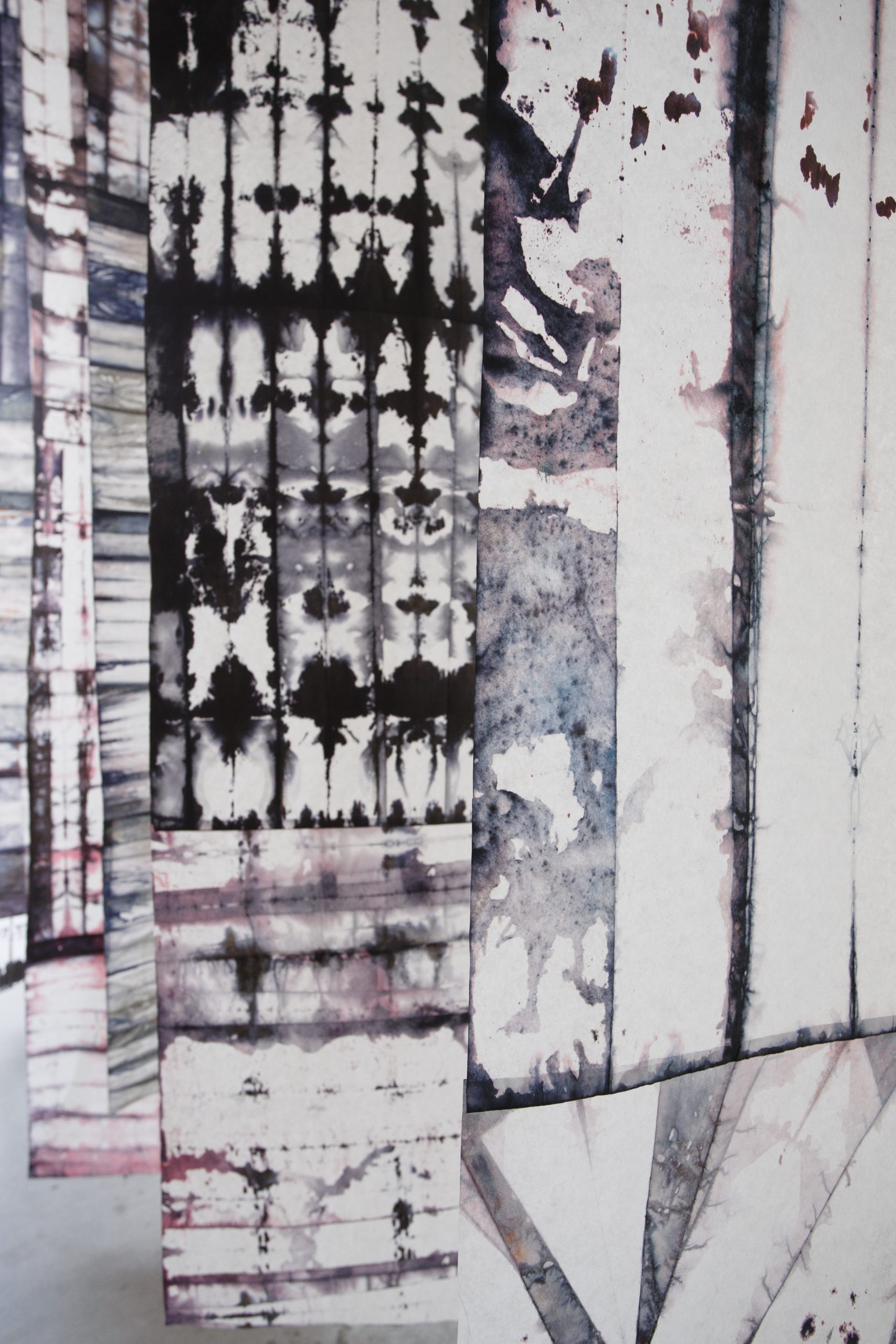
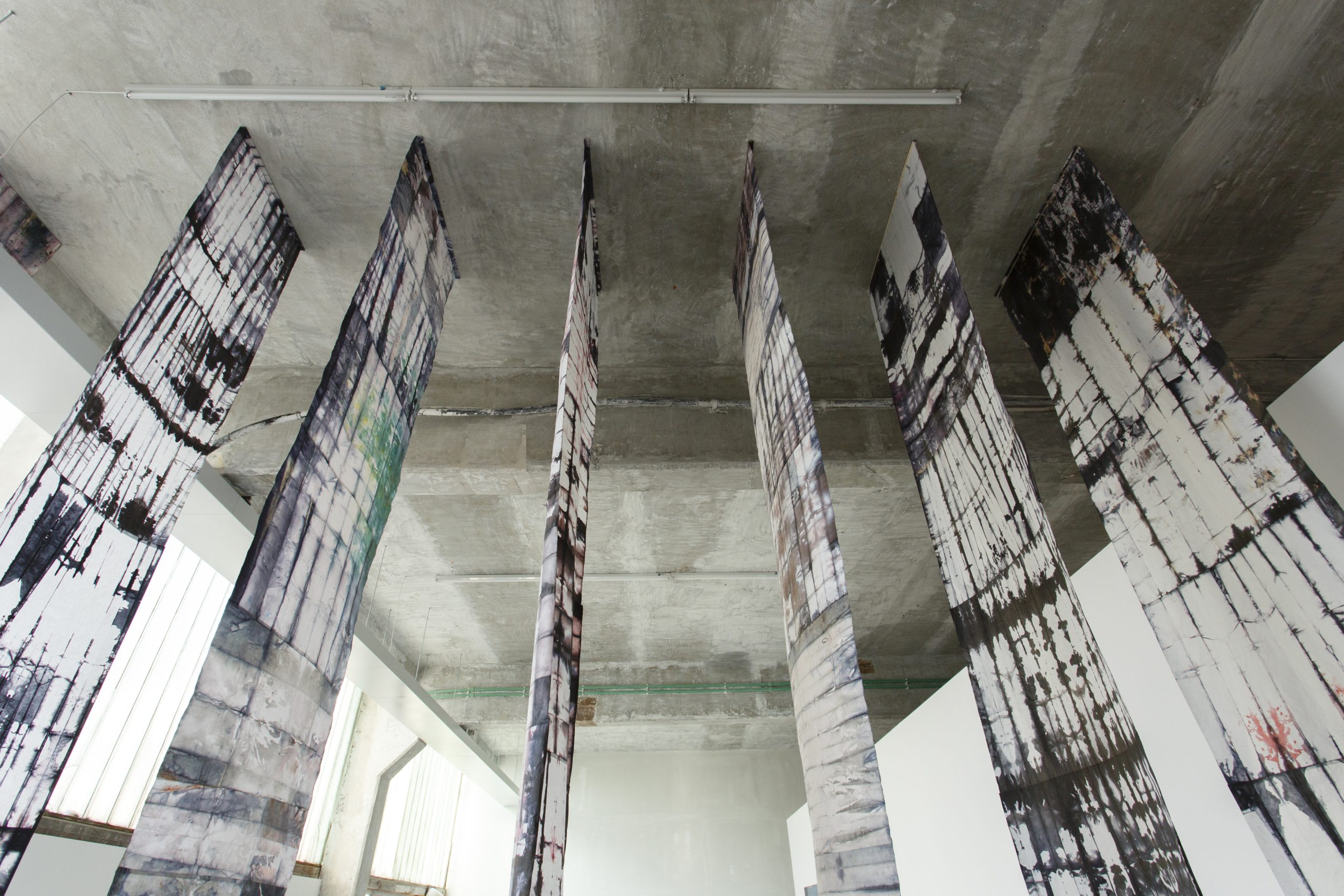
For my intervention, I returned to the “INDIGO” series, which I began in 2017: I gathered and rearranged existing works, created new pieces, and recomposed the universe of the series so that it reflects my current moment of introspection. In these works, touch — both physical and symbolic — takes on a special weight. It becomes a mean of closeness, of knowledge, and of rediscovery. The materials used, especially the dyed silk paper, demand care, attention, and full presence, and the work process transforms into a creative gesture through which I can explore my inner world.
The interview was conducted as part of the cultural project “Breaking the Silence: A Visual Narrative on Emotions Left Unspoken”, co-financed by the Administration of the National Cultural Fund (AFCN). The project does not necessarily represent the official position of the Administration of the National Cultural Fund. AFCN shall not be held liable for the project’s content or any use to which the project outcome might be put. These are the sole responsibility of the beneficiary of the funding.