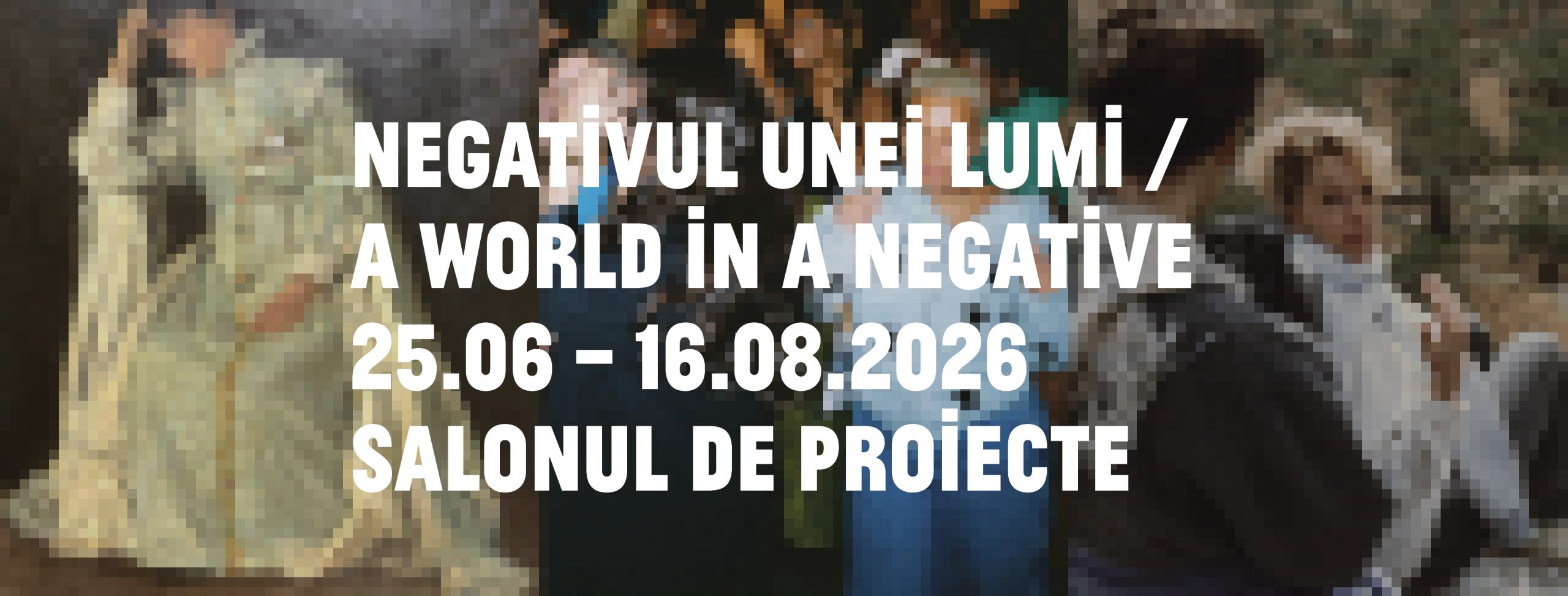
The group exhibition “A World in a Negative” will open on Thursday, June 25, 2026, at Salonul de proiecte in Bucharest. The project brings together works and contributions by Mona Vătămanu & Florin Tudor, RIWAQ – Centre for Architectural Conservation, Space Black, Chlorys, Atelier Ad-Hoc (Maria Daria Oancea & George Marinescu), and Ovidiu Țichindeleanu, curated by Corina Oprea and supported by research conducted by Ana-Maria Ștefan. The exhibition proposes a reflection on how image, memory, and space can be read “in negative,” as a layer of interpretation of the contemporary world.
“A photographic negative is neither the image nor its absence. It is a surface where light leaves an imprint, preserving traces that are not yet fully visible. Scratches, interruptions, overexposures, and reversals become part of the image itself. What emerges is not a complete picture but a field of relations through which history appears in fragments.
A World in a Negative attends to the imprints in art and architecture as forms of resistance: to what remains after rupture, what persists despite erasure, and what can still emerge from fragments. Bringing together newly commissioned artworks, architectural histories, sonic works, and archival materials, the exhibition traces connections between Romania, Sudan, and Palestine through their material afterlives. Moving between artistic reflections on paintings damaged during the Romanian Revolution of December 1989, the history of the National Assembly building in Khartoum designed by Romanian architect Cezar Lăzărescu, and archives marked as much by absence as by preservation, the exhibition considers how memory is carried, contested, and reconstructed. Its display unfolds as a material proposition, drawing on the language of construction, scaffolding, textiles, and formwork to create a space that is at once archive, parliament, and gathering place—an agora where traces of the past enter into conversation with the present.
In a newly commissioned series of twelve photographs, Mona Vătămanu & Florin Tudor reflect on the artwork as an act of resistance through images of paintings from the collection of the National Museum of Art of Romania that were struck by bullets during the Romanian Revolution of December 1989. Echoing Gilles Deleuze’s notion of a “fundamental affinity” between art and resistance, the series attends to both the traces of violence and the processes of conservation and restoration that have enabled these works to endure. More than three decades after the events, approximately 85 percent of the damaged paintings have been restored, while others continue to bear visible scars. Moving between trauma and repair, the photographs reveal cultural heritage as a site where violence and restoration remain materially inscribed.
These histories enter into dialogue with architectural archives and research by RIWAQ – Centre for Architectural Conservation, whose work over the past three decades has documented, restored, and activated Palestinian architectural heritage. Presented publicly in an exhibition context for the first time, the RIWAQ archive unfolds through geographical, chronological, and material constellations, tracing changing understandings of heritage across Palestine from the 1980s to the present.
Alongside these materials, a selection of six Palestinian embroideries from the collection of the National Museum of History points to embroidery as a living repository of memory, knowledge, and belonging. Much like architecture, Tatreez encodes local histories, geographies, and communal forms of transmission. The motifs stitched into fabric function as cultural maps that continue to sustain Palestinian identity and resilience across displacement, occupation, and diaspora.
Space Black’s contribution traces the often-overlooked social and cultural ties that emerged through the historical relationship between Sudan and Romania, focusing on the lives, memories, and exchanges that unfolded beyond diplomatic agreements and official records. Drawing on archival research, personal testimonies, photographs, and materials gathered through workshops, the installation brings together fragments of a dispersed archive that documents experiences of migration, education, friendship, and solidarity across generations. Textiles and domestic elements situate these materials within a space of encounter, foregrounding forms of knowledge preserved through family collections and community memory.
Extending these inquiries through sound, Mihaela Vasiliu (Chlorys) develops an auditory layer for the exhibition composed of field recordings, archival fragments, and sonic traces gathered around buildings designed by Cezar Lăzărescu, including Sala Omnia, Bucharest Airport, and the Black Sea coast. Sound becomes a medium through which architectural histories, memories, and political imaginaries continue to resonate across time and geography.
A series of propositions by philosopher Ovidiu Țichindeleanu offers a framework through which to approach the historical, political, and epistemic conditions that shaped relations between Romania, Sudan, and Palestine during the second half of the twentieth century. Through archival documents, diplomatic correspondence, publications, and transcripts, his research follows a constellation of political, economic, and cultural exchanges that emerged within broader movements of decolonization and international solidarity, when alternative models of cooperation were being imagined across Africa, the Middle East, and Eastern Europe. Read alongside the archival materials, these propositions draw attention to the categories, assumptions, and forms of knowledge through which such relations were negotiated and remembered.
A World in a Negative proposes a constellation of traces, echoes, and unfinished histories that point towards a museum of solidarity: one attentive to repair and the fragile connections that continue to shape the present.
For the exhibition, Atelier Ad-Hoc develops the spatial framework, drawing on practices of reuse, adaptation, and collective construction. Bringing together architectural references that resonate across Romania and Sudan, the structure remains intentionally open, supporting the exhibition’s understanding of the museum as a space of encounter, assembly, and exchange.
The exhibition will be activated in July through a special book club session organized by the interdisciplinary collective Nazra, dedicated to Sudanese literature. The gathering will be accompanied by a tasting of Palestinian dishes, creating a space of encounter that brings together cultural practices, gestures of hospitality, and forms of solidarity. In doing so, it extends the exhibition beyond its physical framework toward collective experiences of learning, sharing, and conviviality.” (curatorial text)
The exhibition can be visited between June 26 and August 16, 2026.