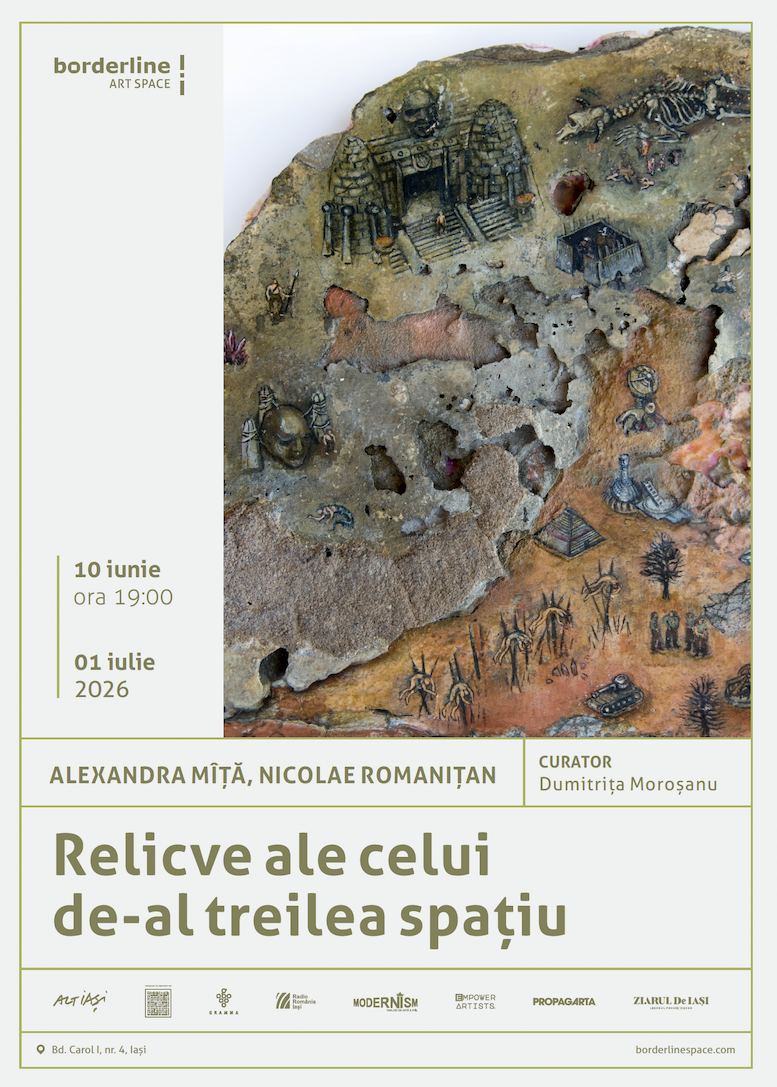
On Wednesday, June 10, at 7:00 PM, Borderline Art Space in Iași will open “Relics of the Third Space”, an exhibition of painting and sculpture by Cluj-based artists Alexandra Mîță and Nicolae Romanițan. Curated by Dumitrița Moroșanu, the exhibition will be inaugurated with a site-specific performance by Alexandra Mîță, scheduled for 7:30 PM.
The concept of the “third space,” derived from the postcolonial theory of Homi K. Bhabha, describes a space produced through the negotiation of different identities, generating an ongoing process of transformation and hybridity. Within the exhibition, fragmentation becomes a central visual principle. Negotiations between personal and collective identities, canonical representations and post-human beings are imbued with layered meanings and often approached through the irony and contradictions characteristic of the grotesque.
Historically, the grotesque has emerged as a response to moments of profound cultural change—from its rediscovery in the subterranean ruins of the Domus Aurea during the Renaissance to contemporary imaginaries shaped by avatars and virtual realities. In this context, postmodernism’s tendency to depart from established norms has generated new forms of hybridity that both challenge and coexist with inherited traditions. Technology, myth, and affect intersect to create absurd yet compelling landscapes belonging to a space that is simultaneously sacred and contemporary. Haunted by feelings of alienation and solitude, as well as apocalyptic environments that invite reflection on existence and society, both artists combine an engagement with materiality and technique with references to the canonical history of art, archaic mythologies, and personal experience, constructing richly layered hybrid worlds.
Alexandra Mîță’s sculptures and performances employ the human figure—with all its complex moral and psychological associations—to create anthropomorphic mythical artefacts that merge repulsion and curiosity into an experience that is at once fascinating and unsettling. Each work emerges from an extensive process of introspection and maturation, in which art functions as ritual and ritual becomes a form of knowledge. Working from casts of her own body that she rehydrates and manually covers in wax, while incorporating aluminium, bronze, and animal-derived materials, the artist produces creatures that are, quite literally, fragments of her own body. Physical distortions and exaggerations are rendered with delicacy and realism, expressing both personal anxiety and broader social tensions. Decay coexists with regeneration, while vulnerability intertwines with the grotesque.
In contrast, Nicolae Romanițan’s paintings draw upon the caricatural dimensions of the grotesque through a visual language that combines medieval iconography with proto-digital imagery, references to video games, television series, magazines, and manuscripts. Portrait conventions associated with Byzantine, Gothic, and Flemish painting merge with fragments of early-2000s visual culture to create speculative environments suspended within technological and existential collapse. Working on reclaimed walls, wood panels, and other salvaged supports, Romanițan treats material as a surface already saturated with memory, adapting his interventions to existing traces and fractures. His series function as contemporary reinterpretations of medieval narratives, populated by apocalyptic scenes, maps transformed into algorithms, digital interfaces, and creatures suspended between death and simulation. Within these worlds, technology becomes both an object of nostalgia and an instrument of alienation, while the images appear as fragments recovered from a future archaeological site where the remnants of humanity coexist with its devices and technological fantasies.
Alexandra Mîță, born in Brașov in 2003, is currently pursuing a Master’s degree at the University of Art and Design in Cluj-Napoca, where she also completed her BA in Sculpture. Her practice brings together sculpture and performance through the use of body casts, wax, aluminium, bronze, and animal-derived materials, exploring tensions between fragility and grotesqueness, decay and regeneration. Recent exhibitions and projects include Instances of Aloneness (Cosmic House, Cluj-Napoca, 2025), Young Blood 0.5 (Art Safari, Bucharest, 2025), Meet My Eyes (Cluj-Napoca Art Museum, 2025), participation in the International Biennial for Students in Palma de Mallorca (2025), the performance Dehumanization (Casa Matei, Cluj-Napoca, 2025), and Bruises (Connector Gallery, Cluj-Napoca, 2024).
Born in Cugir in 1991, Nicolae Romanițan studied Graphic Arts at the University of Art and Design in Cluj-Napoca. Working across painting, sculpture, and drawing, he constructs visual universes that overlap medieval iconography, digital culture, and fragments of printed media. Recent exhibitions include Overlapping Dwellings: From Brancusi to Ghenie (group exhibition, Darvas-La Roche House, Oradea, 2026), Wild at Heart and Weird on Top (AnnArt Gallery, Bucharest, 2026), Transylvanian Painting Today (Telegraph Gallery, Olomouc, Czech Republic, 2026), Weltschmerz Melancholia (solo exhibition, Biju Gallery, Cluj-Napoca, 2025), Le temps des Objets Tranchants (59 Rivoli Gallery, Paris, 2025), A Territorial Hope Affair (Salon de Papier, Bucharest, 2024), and An AI Walks into a Bar (French Institute of Romania in Cluj-Napoca, 2024).
The exhibition runs from June 10 to July 1, 2026, and is organized by Borderline Art Space through the AltIași Cultural Association as part of the project “Flows & Sediments”, co-funded by the Romanian National Cultural Fund Administration (AFCN).
The project does not necessarily represent the position of the National Cultural Fund Administration. AFCN is not responsible for the content of the project or for the ways in which its results may be used. Responsibility rests entirely with the funding beneficiary.