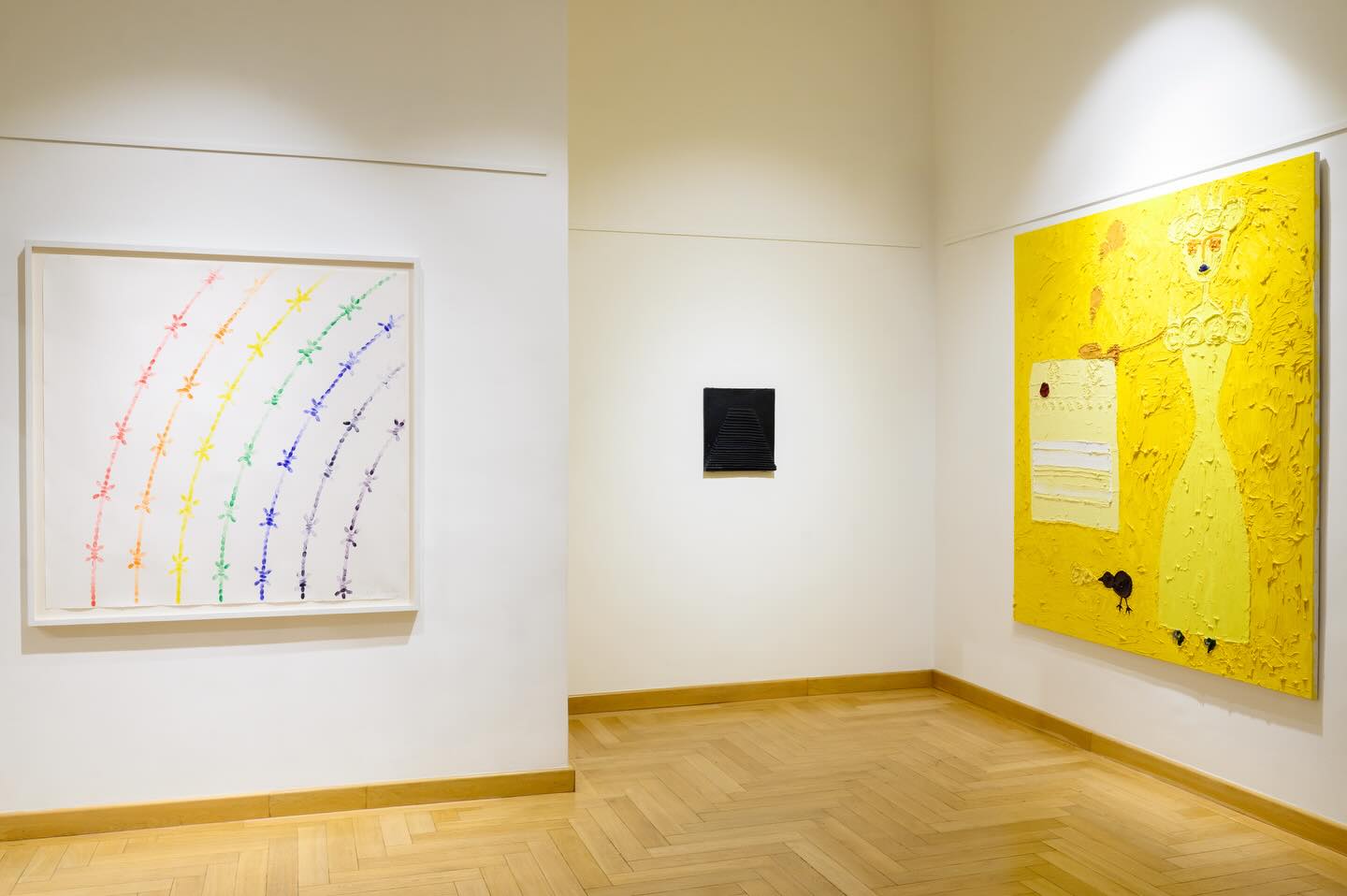
The exhibition DREAMSCAPES, organized by Mobius Gallery at the Multicultural Center of Transilvania University in Brașov, between December 5, 2025 and January 7, 2026, brought together a selection of works from Avi Cicirean’s collection, signed by Mircea Cantor, Cristina Chirilă, Horia Damian, Andrei Gamarț, Ion Grigorescu, Gili Mocanu, Sultana Maitec, Laurian Popa, Radu Pandele, Lea Rasovszky, Roman Tolici, and Ecaterina Vrana.
DREAMSCAPES offers a fragment of the Cicirean Collection, presenting a map of visual practices from recent decades, articulated through the personal gesture of collecting. Bringing together works by 12 artists, created between 1972 and 2024, the exhibition opens a territory where reality subtly overlaps with the mythology of dreaming. Between individual memory and collective perspective, autobiographical reference and recent art history, the Cicirean Collection functions as an archive in continuous evolution and transformation. Each work is both a subjective choice—born from the intimate act of collecting—and an objective tracing of the developments within the Romanian art scene after 2000.
The exhibition brings together works by artists Mircea Cantor, Cristina Chirilă, Horia Damian, Andrei Gamarț, Ion Grigorescu, Gili Mocanu, Sultana Maitec, Laurian Popa, Radu Pandele, Lea Rasovszky, Roman Tolici and Ecaterina Vrana. Each piece unfolds like a fragment of a dream, suspended between reality and projection, while the exhibition structure outlines a non-linear narrative—an unpredictable path with shifts between abstraction and figuration, geometry and gesture.
Avi Cicirean’s connection to art traces back to childhood, shaped by the artistic environment in which he grew up, including the paintings and sculptures of his grandfather—a universe that established his earliest visual reference points. Over the past fourteen years, this early familiarity has evolved into a coherent pursuit of contemporary art, in which encountering artworks becomes both an exercise in understanding and a form of self-definition. Presenting the collection in a public exhibition thus becomes an act of self-revelation and a means of transforming the collector’s private experience into a shared space.