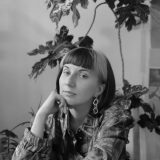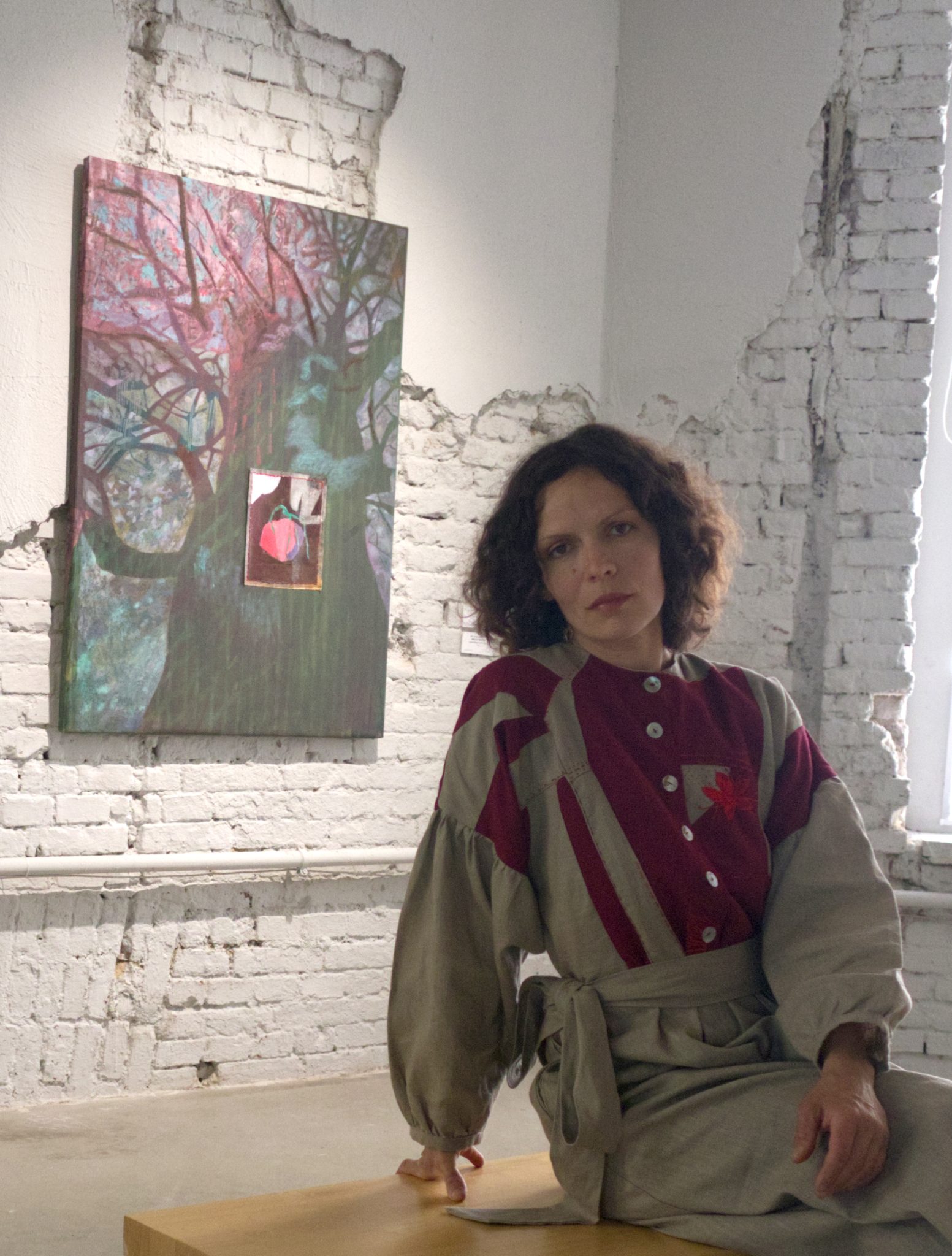
In a contemporary artistic landscape often dominated by the spectacular and immediate visual impact, Maia Ștefana Oprea’s practice stands out through its meditative consistency and constant pursuit of depth. Her art rejects superficiality, instead proposing a lucid exploration of the relationship between body, nature, and memory. For the artist, painting, drawing, and the installation become tools of knowledge rather than mere means of expression — forms through which she seeks to understand and restore an inner world permeated by fragility, time, and reconnection.
Her artistic approach upholds the idea that contemporary art should not only be viewed but also lived as a cognitive and emotional experience. Through her works, Maia Ștefana Oprea revisits an essential discussion about the role of the artist as both a critical observer and a witness to a transforming world. For this reason, the present interview aims to explore not only the artist’s visual universe but also her stance on notions such as materiality, time, and vulnerability — themes that run throughout her entire body of work.
Ada Muntean: Your works often incorporate the idea of passage, dissolution, or memory of gesture. What role does time play in the construction of an image, and how is the ephemeral reflected in the materiality of a piece?
Maia Ștefana Oprea: Time, for me, is invisible matter — profoundly present throughout the artistic process, and the very subject of my searches.
I work extensively with materials that have been recovered or already marked by time: torn and stained clothes of the children, paper that has been written on and soaked in recycled oil, chard and arugula seeds mixed with crushed eggshells, millions of tiny, colored plastic fragments from toys once received or longed for, soil, branches. I like to preserve the consistency that the ephemeral acquires, allowing it to be conserved for a while — exhibited or stored — only for the works to later be revisited, transformed, losing their initial forms, colors, or textures, sometimes becoming “something” entirely different. For me, it’s a way of being honest, a coexistence between memory and disappearance.
Time is our silent co-author. It continues to work where I stop, and the final picture is never truly “final” — it is merely a state of passage.
A.M.: The relationship between the human body and the natural environment is a constant of your work. How do you approach this fragile boundary between the inner and the outer, between the living body and the organic context in which it manifests?
M.Ș.O.:The boundary between body and nature is, for me, a breathing border. I am not interested in their separation, but rather in the ways they merge, contaminate one another, and regenerate through each other. My works are often life fragments that attempt a return — an effort to restore balance between what is alive within me and what is alive in the world.
I’m drawn to the subtle relationships between the body’s interior and the elements of nature: water, air, plants, forests. I’m interested in physical labor — working in the garden, carrying water from the spring, harvesting crops — the body’s bond with the soil as a form of energetic connection, clean nourishment (foraging, mushrooms), swimming as an experience of total immersion. All these are gestures I’m drawn to, that I practice, and that manifest organically in my work as natural extensions of the inner self.

A.M.: You often choose fragile materials or experimental, sometimes unstable, processes. How does the material relate to the idea, and what nuances does fragility acquire in your artistic practice?
M.Ș.O.: Experimental and installation-based processes serve, for me, as a counterbalance to the practice of easel painting, which I’ve pursued for 25 years. Even when I work with fragile materials, I remain concerned with the longevity of the works and their relationship to the environment in which they are stored — a condition often precarious in a rural context. I’m fascinated by Henri Focillon’s notion of the “living form,” for whom form possesses an existence of its own, independent of the artist’s intention — capable of evolving, breathing, and generating new meanings.
Often, I am surprised to find that the idea only emerges once the form has stabilized. Thus, fragility becomes a tool for reflection on impermanence and relational art, rather than on the lasting object.
A.M.: In your practice, drawing seems to function more as a method of gaining knowledge than just a formal tool. How do you define drawing — as a cognitive process, a material presence, or a form of meditative expression?
M.Ș.O.: Drawing is when you feel like screaming, but it’s night, and your only neighbors are two hundred sheep fenced in by six guard dogs and two shepherds.
Drawing is when you’re falling asleep on your feet, but your child is wide awake in the middle of the night, and you hand them a pen to cover you from head to toe.
Drawing is the line of half-buried stakes for the circular raised beds in which you’ll never get the chance to plant anything.
The gestural drawing of limbs that look bright orange while you swim in the marsh near the Baltic Sea.
Drawing is both on the outside and on the inside, fast and slow, painful and liberating, carefully considered and profoundly reckless — but above all, it’s something you never give up on, something you always return to.


A.M.: Your artistic approach reflects an ethical care toward nature and fragility. Do you see yourself constructing an ecological discourse, or rather developing a visual-poetic exploration of the human–environment relationship?
M.Ș.O.: It’s a beautiful and painful paradox at the same time: I feel that my ecological discourse is so deeply internalized that it sometimes becomes invisible — because it exists through process, it’s organic, not declarative. For me, ecology is not a militant stance but a way of being in the world with attention and respect toward life. It is a practice of interdependence between body, matter, and landscape — an affective and perceptive ecology that manifests through gestures of observation, care, and coexistence.
Yes, I do believe I have an ecological practice, in the extended, ethical-poetic, and relational sense of the term — one in which ecology is more an attitude than an explicit message. It is my way of resisting many aspects of contemporary society that I neither understand nor desire.
A.M.: Your works, though deeply intimate, activate a subtle relationship with the viewer. How do you see their position in front of your work — as a witness, a participant, or an extension of your inner process?
M.Ș.O.: It varies from case to case. Sometimes I invite the audience to take an active role in the creative process — to draw alongside me or to add small elements to a participatory installation. At other times, my works remain rather hermetic, allowing each viewer to position themselves differently in relation to them. I don’t like to illustrate concrete things, scenes, or moments; I prefer to suggest, to build an atmosphere. In this way, the viewer can take over my story and continue it in whatever direction they wish, following their own thread of thought.

A.M.: What directions do you feel are opening up in your practice now, beyond your already articulated interests, and what projects would you like to bring to life in the future?
M.Ș.O.: So many. Most of the time, we daydream, only to return to our small everyday lives and set those dreams aside. The main direction — the one that has remained “closed off” for quite some time — is my return to drawing and painting on large surfaces. I’m deeply interested in scientific research, which I intertwine with my artistic explorations, and I want to expand my current projects to a European level. I hope to bring together as many wonderful people as possible to Grădina Ideilor (transl. The Garden of Ideas) — launched in Nucșoara, Argeș, in 2021, and now hosting its first group exhibition this November. In the long term, I would like to initiate cultural projects within the rural communities where I have relocated.
A.M.: The exhibition Breaking the Silence: A Visual Narrative on Emotions Left Unspoken suggests a dialogue about unspoken emotions. How does silence translate for you within the artistic process? Is it a form of introspection, protection, or a fertile ground for reflection and creation?
M.Ș.O.: It is a form of protection, of inwardness, but also the space where gesture, matter, and emotion meet and transform. Silence makes possible a deeper observation, focus, and the emergence of hidden meanings beyond the noise of words. I’ve spent hundreds of hours sewing my installation, often in the midst of nature — in the Făgăraș Mountains, by the river, in the forest, on meadows, under the walnut tree — where silence takes on a different form. If you’re attentive enough, you begin to merge with everything around you: plants, birds, waters.
A.M.: How did the presence of your works take shape within the collective context of the exhibition? Are you interested in the way a work’s meaning changes when it’s placed within a shared narrative, such as the one proposed by Breaking the Silence: A Visual Narrative on Emotions Left Unspoken?
M.Ș.O.: The meaning of the works inevitably shifts when they enter a shared narrative — they interact with the other artists’ works and with the exhibition space itself. My installations Travailler Ensemble and Don’t Look Back were created and completed specifically for this exhibition path. I enjoyed the challenge of working on a large scale, something I had long desired, and this aspect, together with the theme, became the thread that connects the works. I’m very pleased with how they integrated into the exhibition’s context — I think they’ve made quite a few friends in the mall.
A.M.: If you had to condense your artistic practice into a single word, what would it be?
M.Ș.O.: NO


The interview was conducted as part of the cultural project “Breaking the Silence: A Visual Narrative on Emotions Left Unspoken”, co-financed by the Administration of the National Cultural Fund (AFCN). The project does not necessarily represent the official position of the Administration of the National Cultural Fund. AFCN shall not be held liable for the project’s content or any use to which the project outcome might be put. These are the sole responsibility of the beneficiary of the funding.